Jet Dreams on the Family Driveway: The Fighter Plane That Launched America's Tail Fin Obsession
Jet Dreams on the Family Driveway: The Fighter Plane That Launched America's Tail Fin Obsession
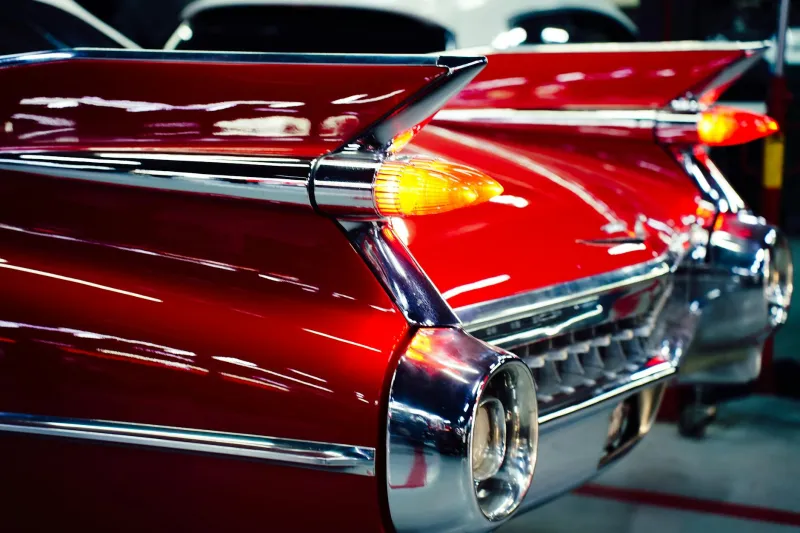
Look at a 1959 Cadillac Eldorado long enough and it starts to feel less like a car and more like a declaration. The tail fins rise nearly a foot above the trunk, capped with bullet-shaped taillights that glow red in the dark. The chrome is everywhere. The whole thing looks like it's moving even when it's parked, like it's straining against gravity, waiting for clearance from an air traffic controller.
This was not an accident. It was the end result of a decade-long styling obsession that started with one General Motors designer sneaking a look at a military aircraft he wasn't supposed to see — and deciding that American cars needed to look exactly like that.
The Man Who Saw the Jet
In 1941, a GM designer named Harley Earl was given rare access to Selfridge Army Air Field in Michigan, where the military was testing a new Lockheed fighter: the P-38 Lightning. The aircraft was classified, and civilian access was tightly restricted. Earl, who by this point had already reshaped American automotive design with the sweeping curves of the 1938 Buick Y-Job concept car, walked away from that visit with something lodged in his imagination.
The P-38 was unlike anything in the civilian visual vocabulary of the time. Twin tail booms flanked a central nacelle. The fuselage tapered to distinctive dual vertical tail fins. It was aggressive, purposeful geometry — the visual language of speed and power rendered in aluminum and steel. Earl had seen the future, and it had fins.
World War II delayed the application of that vision. Automobile production essentially halted during the war years as factories converted to military manufacturing. But when the industry came roaring back in the late 1940s, Earl was ready.
The 1948 Cadillac and the Start of Something
The first tail fins appeared on the 1948 Cadillac — subtle by what would come later, barely a raised crease above the rear fender, but deliberate and directional. Earl's team had translated the P-38's twin tail booms into automotive sheet metal. The taillights were positioned to evoke the jet's exhaust ports. The message, even in restrained form, was unmistakable: this car belongs to the same world as military aviation.
Consumer response was enthusiastic enough to encourage escalation. Through the early 1950s, the fins grew. Other GM brands adopted variations of the theme. Chrysler, watching GM's sales figures, developed its own fin language under designer Virgil Exner, who leaned even harder into the aerospace aesthetic with his "Forward Look" designs of the mid-1950s. Ford followed. By the middle of the decade, tail fins weren't a Cadillac signature — they were an industry-wide commitment.
Why America Was Ready for This
The timing wasn't coincidental. The postwar United States was in a particular psychological state — flush with economic optimism, proud of its industrial and military power, and simultaneously anxious about the Soviet Union and the nuclear age. The space race was beginning. Jet travel was becoming real for ordinary Americans. The future felt imminent and exciting and a little terrifying all at once.
Tail fins gave the family car a way to participate in that moment. A 1957 Chevrolet Bel Air sitting in a suburban driveway in Ohio was, visually, a vehicle that belonged to the jet age. It communicated progress, modernity, and American confidence in a form that a family of four could drive to church on Sunday. The fins weren't just styling. They were ideology with chrome trim.
Advertising leaned into this shamelessly. Car ads of the era placed vehicles against rocket launch imagery, fighter jet silhouettes, and illustrations of futuristic cities. The language was explicitly aspirational: these cars weren't just transportation, they were a preview of what America was becoming.
The Peak and the Crash
The 1959 model year represented something close to maximum fin. The Cadillac Eldorado and DeVille wore the largest fins the American industry ever produced — soaring, pointed, genuinely dramatic. The Chrysler 300E and the Dodge Custom Royal weren't far behind. If you wanted a family car that looked like it had been designed by someone who'd just watched a rocket launch, 1959 was your year.
And then, almost immediately, the cultural tide shifted.
By 1960 and 1961, the fins were already shrinking. Automotive critics who had been relatively quiet during the boom years began writing about excess, about styling for its own sake, about cars that had become theatrical props rather than functional objects. The influential social critic Vance Packard had published "The Hidden Persuaders" in 1957 and "The Waste Makers" in 1960, and a broader conversation about American consumerism and planned obsolescence was gaining traction.
The compact car movement accelerated the retreat. Volkswagen's Beetle, which had been gaining American sales through the late 1950s with an advertising campaign that openly mocked Detroit excess, was making a cultural argument as much as a commercial one. The fins looked, suddenly, like a joke about themselves.
Harley Earl retired from GM in 1958, just as the aesthetic he'd built was cresting. His successor, Bill Mitchell, began the process of pulling back — longer, lower, cleaner lines replaced the aeronautical drama. By 1964, the tail fin was essentially gone from American production cars.
What the Fins Were Really About
The rise and fall of the American tail fin is a compressed version of a larger story about how cultural moments express themselves through design. The fins weren't irrational. They were a precise translation of postwar American feeling — the optimism, the prosperity, the genuine excitement about technology and the future — into sheet metal.
When the feeling changed, the design changed. When Americans started questioning whether bigger and more dramatic was always better, the fins came down as quickly as they'd gone up.
Harley Earl saw a classified fighter jet in 1941 and spent the next two decades trying to put that feeling into a car. For a while, the entire country agreed with him. Then it didn't. That's how design works — and it's a pretty good description of how culture works too.