Running on Empty and Guessing: The Long, Strange Delay Before Cars Could Tell You How Much Gas Was Left
Running on Empty and Guessing: The Long, Strange Delay Before Cars Could Tell You How Much Gas Was Left
There's a moment most drivers have experienced at least once: that low-fuel warning light flicking on somewhere inconvenient, triggering a quick mental calculation of how far the nearest gas station might be. It's mildly stressful. But it's also a reminder that someone, at some point, built a system specifically designed to warn you before things got worse.
For the first twenty or so years of automobile history, no such system existed. Drivers operated entirely on guesswork, habit, and the occasional unpleasant surprise. The fuel gauge — that simple dial you glance at a dozen times on every drive — didn't come standard on American cars until well into the 1920s, and it wasn't universally adopted until even later than that.
The story of why it took so long is equal parts practical history and quiet comedy.
The Dipstick Era
When the first gasoline-powered automobiles appeared in the 1890s, fuel tanks were simple metal containers bolted somewhere on the chassis — often under the seat, sometimes at the front, occasionally in positions that made accessing them genuinely inconvenient. There was no instrument to measure what was inside.
If you wanted to know how much fuel you had, you did what you'd do with an oil drum in a barn: you opened the cap and stuck a rod in. Literally. Early drivers carried calibrated dipsticks — not unlike the oil dipstick still used in modern engines — and checked their fuel level by hand before long trips or whenever they felt uncertain.
This worked, after a fashion. It required the driver to stop, get out, open the tank, insert the stick, read the level, wipe it off, and replace everything. On a short trip around town, most drivers simply didn't bother. They kept rough mental track of their mileage and hoped for the best.
Running out of gas was common enough that it wasn't considered a serious failure of planning. It was just something that happened. Early motorists expected a certain amount of inconvenience as part of the deal.
Cork Floats and Creative Improvisation
As cars became more popular in the early 1900s, some manufacturers and aftermarket tinkerers began experimenting with more elegant solutions. One early approach used a cork float inside the fuel tank connected to a rod that poked up through the cap — as the fuel level dropped, the rod descended, giving a rough visual indication without requiring the driver to open anything.
This was an improvement, but only a modest one. The float systems were crude, prone to sticking, and often inaccurate. They also required the driver to look at something near the tank itself rather than at a central instrument panel, which in the early days didn't really exist as a concept.
Other drivers developed personal rituals. Some filled their tanks at the same point every day regardless of level. Others tracked mileage obsessively, knowing their car's approximate range and calculating accordingly. Long-distance travelers — a small but growing group — often carried spare fuel in cans strapped to the running board, bypassing the problem of measurement entirely by simply bringing more than they thought they'd need.
None of this was particularly safe, and spare fuel cans strapped to the outside of a moving vehicle introduced their own category of hazard. But safety, in the early automobile era, was not the dominant design consideration it would eventually become.
Why Automakers Didn't Rush
It's worth asking why manufacturers took so long to address something that seems, in retrospect, like an obvious necessity.
Part of the answer is that early automakers were solving a very long list of problems simultaneously. Engines were unreliable. Tires failed constantly. Brakes were primitive. Steering systems were heavy and imprecise. In that context, a fuel gauge was a comfort feature, not a safety critical one — and comfort features cost money and added complexity to vehicles that were already temperamental enough.
There was also a customer expectation issue. Early automobile buyers were, by definition, adventurous, mechanically inclined, and tolerant of inconvenience. They expected to be involved in the operation of their vehicle in ways that modern drivers would find exhausting. Checking your fuel with a dipstick wasn't seen as a design failure — it was just part of driving.
As long as buyers accepted that, manufacturers had little competitive pressure to change it.
The Studebaker Moment
The turning point came gradually, then all at once. By the mid-1910s, dashboard instruments were becoming more common — speedometers, odometers, and basic engine gauges started appearing on higher-end models. The idea of a centralized instrument panel, giving the driver information at a glance, was taking hold.
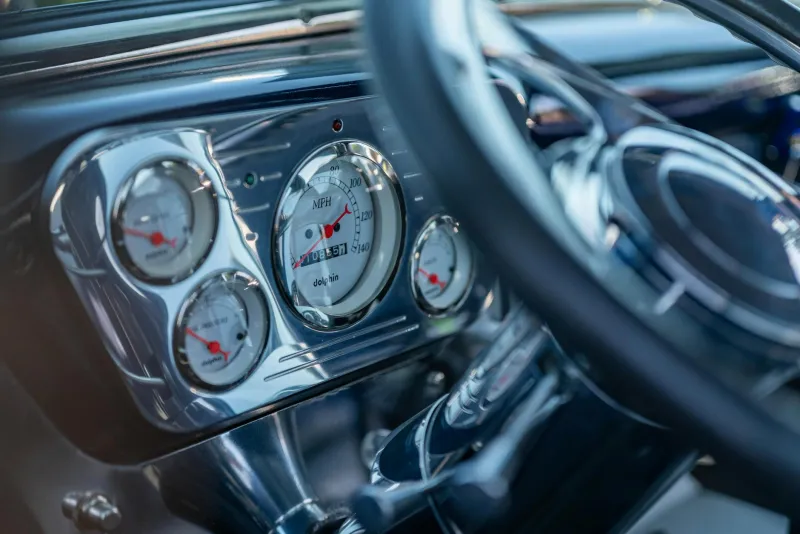
The fuel gauge arrived in this context. Exactly who standardized it first is a matter of some historical debate, but the Studebaker is frequently cited among the early American adopters of a proper dashboard-mounted fuel gauge in the late 1910s and early 1920s. Other manufacturers followed through the early 1920s as the gauge became an expected feature rather than a luxury addition.
By the late 1920s, most new American cars included a fuel gauge as standard equipment. The dipstick check, for fuel at least, became obsolete.
But "standard" didn't mean "reliable." Early fuel gauges were notoriously inaccurate. The sending units inside tanks — floats connected to variable resistors that sent an electrical signal to the dashboard gauge — were sensitive to fuel sloshing, temperature changes, and manufacturing variations. A gauge that read "half" might mean anything from a third to two-thirds, depending on the car, the day, and how level the road was.
This is, incidentally, why the fuel gauge became the instrument most associated with driver distrust. People learned early on not to take it too literally.
What the Gauge Reveals
The delayed arrival of the fuel gauge is a small but telling detail in the larger history of automotive design. For decades, features that protected or informed the driver were treated as optional add-ons rather than fundamental requirements — things that manufacturers included when they felt like it, standardized when the market demanded it, and regulated only when accidents made the absence impossible to ignore.
Seat belts, turn signals, padded dashboards, rearview mirrors — the timeline of safety and convenience features in American cars is full of similar delays. The fuel gauge just happens to be one of the earliest and most mundane examples.
Today, most vehicles don't just show you a gauge — they calculate your remaining range to the mile, factor in your recent driving patterns, and alert you with increasing urgency as the tank drops. It's a long way from a stick in a tank.
But the underlying anxiety is the same. Nobody wants to be the person stranded on the side of the road, staring at an engine that quit because they were paying attention to everything except the one number that mattered.