The Parking Meter Was a Controversial Cash Grab That Nearly Got Banned Before It Took Over Every American City
The Journalist Who Changed How America Parks
On July 16, 1935, a small crowd gathered on the corner of First Street and Robinson Avenue in Oklahoma City to witness what many considered an act of municipal extortion. The city had just installed a strange new contraption—a metal post with a clock face and a coin slot that demanded a nickel for an hour of street parking. Drivers were furious. Business owners were split. And nobody could have predicted that this controversial device would soon define urban life across America.
The man behind this polarizing invention wasn't a city planner or a traffic engineer. Carlton Cole Magee was a newspaper editor and lawyer who had moved to Oklahoma City after his crusading journalism in New Mexico made him too many enemies. But Magee couldn't shake his reformist instincts, and Oklahoma City's downtown parking crisis gave him a new cause to champion.
When Downtown Became a Battleground
By the mid-1930s, Oklahoma City faced the same problem plaguing downtowns across America: too many cars, not enough spaces. Business district employees arrived early each morning, claimed the best spots, and left their cars there all day. Shoppers circled blocks endlessly, searching for somewhere to park. Store owners watched potential customers drive away in frustration.
Magee saw the problem firsthand during his daily commute to the Oklahoma News. The city had tried time limits and police enforcement, but nothing worked. Shop clerks simply moved their cars every few hours, and the handful of traffic cops couldn't monitor every street. Something more systematic was needed.
Inspired by similar experiments in other cities, Magee began sketching designs for an automated enforcement system. His concept was elegantly simple: a mechanical timer that would accept coins and display when parking time expired. Violators would get tickets. The city would collect revenue. Problem solved.
The Birth of America's Most Hated Invention
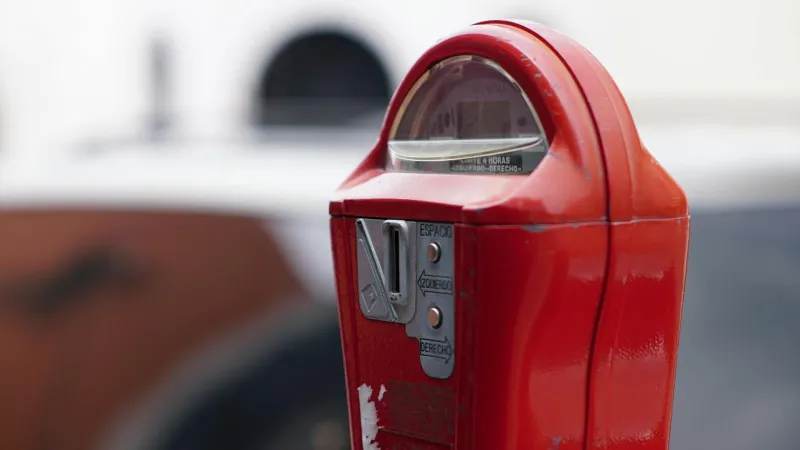
Magee partnered with engineering professor Gerald Hale to build a working prototype. Their "Park-O-Meter" stood about four feet tall, with a large clock face showing remaining time and a bright red flag that popped up when time expired. The design was deliberately visible—Magee wanted both enforcement and deterrence.
But when Oklahoma City announced plans to install 175 meters downtown, the backlash was immediate and fierce. Drivers called it "legalized robbery" and a "tax on fresh air." Local newspapers ran angry editorials comparing the meters to highway bandits. One particularly incensed citizen organized a "Crusade Against the Meter" and threatened to sue the city for unconstitutional taxation of public streets.
The controversy split business owners down the middle. Store managers loved the idea of customer turnover, but many worried about driving shoppers to suburban competitors. Restaurant owners feared diners would avoid downtown rather than pay for parking. Even city council members had second thoughts as public opposition mounted.
The Unlikely Defense of Nickels and Dimes
Despite the uproar, Magee found unexpected allies. Downtown property owners realized that better parking access would increase foot traffic and property values. Police departments saw meters as a way to enforce parking laws without dedicating officers to ticket-writing. And city treasurers, struggling through the Great Depression, couldn't ignore the revenue potential.
The first day's results were mixed but promising. Some drivers paid reluctantly, others defiantly ignored the meters, and a few vandalized them outright. But foot traffic increased, and downtown businesses reported more customers throughout the day. The meters were working, even if nobody wanted to admit it.
Within months, other cities began inquiring about Oklahoma City's experiment. Magee and Hale formed the Dual Parking Meter Company and started fielding orders from across the country. By 1940, meters had appeared in more than 100 American cities, despite continued public resistance.
How America Learned to Stop Worrying and Love the Meter
The transformation wasn't immediate or universal. Some cities banned meters after public outcry. Others installed them only to remove them when businesses complained. But gradually, the economics proved irresistible. Meters generated millions in municipal revenue while solving genuine urban problems.
World War II accelerated adoption as cities desperately needed income and efficient resource allocation. Rationing made every parking space precious, and meters provided a fair, automated way to distribute access. By war's end, the parking meter had evolved from controversial experiment to municipal necessity.
Post-war suburban development might have killed the parking meter, but instead it spread the concept beyond downtowns. Shopping centers installed meters in premium spots. Hospitals used them to manage visitor parking. Universities deployed them across sprawling campuses. The device Oklahoma City residents once called "un-American" became a fixture of American life.
The Hidden Legacy of a Hated Invention
Today, parking meters generate billions in annual revenue for American cities, but their influence extends far beyond municipal budgets. They quietly revolutionized urban planning by making parking a quantifiable commodity rather than a free-for-all. Real estate developers factor meter zones into property values. City planners use parking pricing to encourage public transit and manage traffic flow.
The meter also changed how Americans think about public space. Before 1935, city streets were truly public—available to anyone for as long as needed. Magee's invention introduced the radical concept that public access could be rationed by ability to pay. That principle now governs everything from toll roads to surge pricing.
Carlton Cole Magee died in 1946, just as his invention was conquering cities nationwide. He probably never imagined that his solution to Oklahoma City's parking problem would reshape urban America. But every time you feed quarters into a meter, you're participating in an 90-year-old experiment that started with one frustrated journalist who refused to accept that downtown parking had to be chaos.
The next time you're searching for street parking, remember: the system that frustrates you today once sparked riots, lawsuits, and a nationwide debate about the nature of public space. Sometimes the most controversial innovations become so embedded in daily life that we forget they were ever controversial at all.