The Fifth Wheel's Fall from Grace: How the Spare Tire Went from Status Symbol to Hidden Afterthought
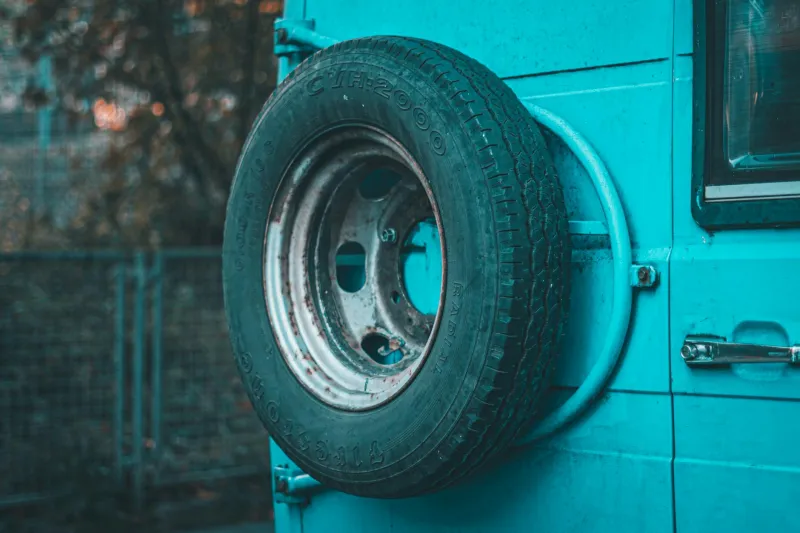
The Fifth Wheel's Fall from Grace: How the Spare Tire Went from Status Symbol to Hidden Afterthought
If you popped the trunk of a car built in the last twenty years, there's a decent chance you'd find a spare tire that looks like it belongs on a golf cart. Undersized, underinflated, and plastered with warnings telling you not to exceed 50 mph, the modern "donut" spare is one of the more honest metaphors in American consumer culture — a backup plan that barely qualifies as one.
But here's the thing: the spare tire wasn't always an afterthought. For the first few decades of the automobile's existence, it rode up front, in full view, mounted on the hood or fender like a badge of honor. Getting demoted to the trunk took decades. Getting replaced by a glorified training wheel took a few more. And most drivers never questioned any of it.
When Flat Tires Were a Daily Reality
To understand why early drivers made such a show of their spare, you have to understand what roads — and tires — were like in the early 1900s. Paved surfaces were rare. Rubber compounds were primitive. A long drive almost guaranteed at least one flat, and in an era before roadside assistance or cell phones, being stranded with no spare wasn't just inconvenient. It could be genuinely dangerous.
So the spare tire wasn't optional equipment. It was survival gear. And since carrying it was non-negotiable, early automakers leaned into the aesthetic. By the 1910s and into the 1920s, cars from manufacturers like Packard, Pierce-Arrow, and even the more affordable Ford models began mounting spare tires on the front fenders — sometimes one on each side — in a way that was visible, deliberate, and frankly kind of bold.
For wealthier buyers, twin sidemount spares became a mark of distinction. The tires were often fitted with chrome rings and fabric covers embossed with the owner's monogram. This was automotive confidence made physical: I am prepared, I have resources, and I'd like you to notice both.
The Slow Migration Toward the Back
As roads improved through the 1930s and tire technology advanced, flat tires became less of a daily hazard and more of an occasional nuisance. That shift quietly changed the calculus on where the spare needed to live.
At the same time, car design was evolving. Streamlining became fashionable — inspired partly by aviation aesthetics and partly by genuine aerodynamic interest — and a tire bolted to the front fender was about as streamlined as a brick. Designers began pushing the spare rearward, tucking it into purpose-built wells at the back of the car, or mounting it externally on the trunk lid.
The fully enclosed trunk, which became standard through the late 1930s and 1940s, sealed the deal. The spare moved inside, hidden under a panel, and the front fenders were freed up for cleaner lines. Practicality had won, but so had aesthetics. The spare tire's public-facing era was over.
What's interesting is how little fanfare accompanied this transition. Nobody mourned the sidemount spare in automotive press at the time. It just... disappeared, absorbed into the trunk alongside the jack and the lug wrench, and drivers adapted without complaint.
Trunk Space vs. Tire Size: The Quiet Tradeoff
Through the postwar boom years and into the 1960s and 70s, the spare tire lived in the trunk as a full-size wheel — the same diameter and width as the tires actually on the car. If you got a flat, you swapped it out, drove normally, and dealt with the flat later. The system worked.
But trunks were increasingly being asked to do a lot. American families were loading them with luggage, groceries, sports equipment, and road trip gear. A full-size spare took up significant real estate, and automakers began looking for ways to reclaim that space.
The answer arrived in the late 1970s: the compact spare, or what most people call the donut. Smaller in diameter, narrower in width, and inflated to a higher pressure to compensate for its reduced size, the donut spare was designed for exactly one purpose — getting you to a tire shop without leaving you stranded on the highway. It was never meant to be a real tire. Chrysler introduced it broadly in the late 1970s, and by the 1980s, it had spread across the industry.
Drivers accepted it with almost no resistance. The spare had been invisible for so long that most people had stopped thinking about it entirely. Shrinking it just made the trunk a little bigger, and that felt like a win.
And Then Some Cars Stopped Carrying One at All
The donut was only a waypoint. In recent years, a growing number of vehicles — particularly electric cars and performance models — have dropped the spare tire entirely, replacing it with a can of tire inflator foam and a number to call. Some rely on run-flat tires that can travel limited distances after losing pressure. Others just assume you'll figure it out.
The logic is straightforward: weight reduction, space efficiency, and the statistical reality that most modern drivers will never experience a catastrophic flat tire in their lifetime. The math works. But there's something telling about the journey from chrome-ringed sidemount spare to an aerosol can stuffed in a door pocket.
The spare tire went from a front-and-center symbol of self-reliance to a hidden convenience to, in some cases, a problem outsourced to a phone app. That arc didn't happen all at once. It happened gradually, one small tradeoff at a time, in ways that felt reasonable at every step.
Which is, when you think about it, exactly how most things change.