The Circle That Conquered America: How One Street Design Quietly Rewrote the Suburban Landscape
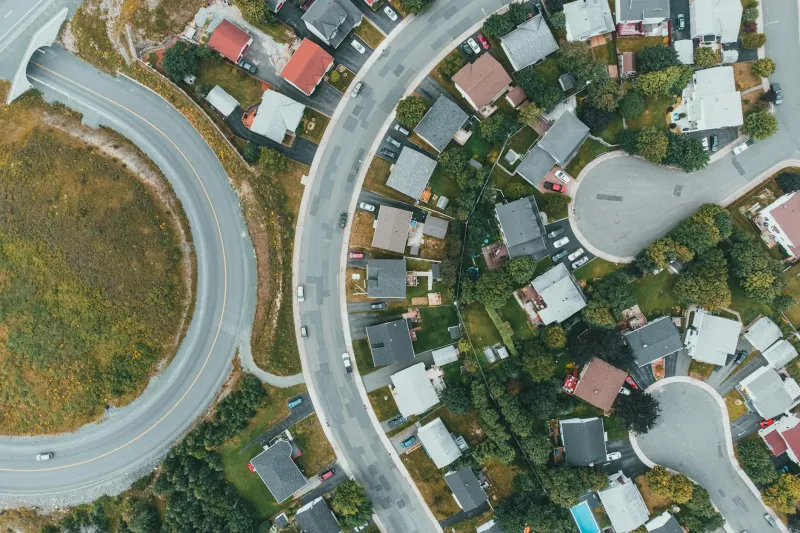
Drive through any American suburb built after 1950, and you'll encounter the same street pattern over and over: winding roads that curve gently before ending in perfect circles lined with houses. These circular dead-ends, known as cul-de-sacs, are so embedded in suburban America that they seem like the natural way to organize neighborhoods.
But the cul-de-sac wasn't natural at all. It was a deliberate design revolution, born from a specific set of postwar anxieties about cars, children, and community. What started as an experimental solution to traffic problems became the dominant organizing principle of American suburbia — and quietly reshaped how an entire nation lives.
The Problem That Started It All
Before World War II, most American neighborhoods followed a simple grid pattern inherited from colonial city planning. Streets ran parallel and perpendicular to each other, creating rectangular blocks that were efficient for utilities, mail delivery, and navigation. But this traditional layout had a problem that became increasingly obvious as car ownership exploded in the postwar boom: through traffic.
In grid neighborhoods, drivers used residential streets as shortcuts to avoid main roads. Families found themselves dealing with a constant stream of cars racing past their front doors, creating noise, safety hazards, and a general sense that their neighborhood belonged more to commuters than to residents.
The Planners Who Reimagined the Neighborhood
The solution came from a group of urban planners led by Clarence Stein and Henry Wright, who had been experimenting with alternative neighborhood designs since the 1920s. They studied English garden city movements and borrowed concepts from early planned communities, but their breakthrough insight was specifically American: they realized that the automobile required fundamentally different neighborhood layouts than previous transportation methods.
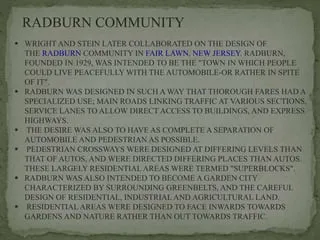 Photo: Clarence Stein, via image.slidesharecdn.com
Stein and Wright developed what they called the "superblock" concept — large residential areas with internal street networks that deliberately discouraged through traffic. The cul-de-sac was the key component: a short street that branched off from collector roads and ended in a circular turnaround, making it impossible for drivers to use as a shortcut.
Radburn: The Laboratory That Launched a Revolution
The first large-scale test of cul-de-sac planning came in 1929 with Radburn, New Jersey — a planned community that Stein and Wright designed as a "town for the motor age." Radburn featured clusters of houses organized around cul-de-sacs, with separate pedestrian walkways that allowed children to walk to school without crossing any streets used by cars.
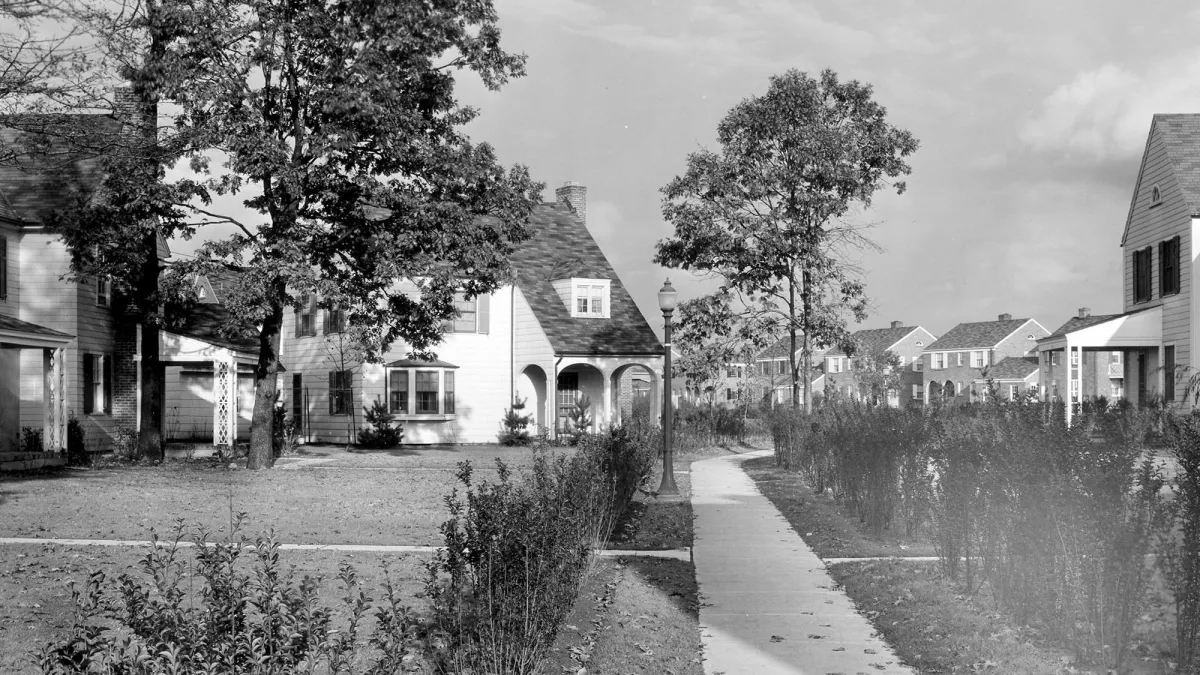 Photo: Radburn, New Jersey, via s30471.pcdn.co
The experiment was interrupted by the Great Depression, but the parts of Radburn that were completed demonstrated something remarkable: families loved living on cul-de-sacs. Residents reported feeling safer, experiencing less noise, and developing stronger relationships with neighbors. Children played in streets that felt more like extended driveways than public thoroughfares.
The Postwar Explosion
After World War II, returning veterans and the baby boom created unprecedented demand for new housing. The Federal Housing Administration, eager to standardize suburban development, began promoting cul-de-sac designs as the ideal layout for family neighborhoods. FHA guidelines specifically recommended dead-end streets as safer alternatives to grid patterns.
Developers embraced the cul-de-sac for practical reasons beyond safety. The curved, organic street layouts allowed them to build on irregular terrain that would have been difficult to develop with rigid grids. They could work around hills, streams, and existing trees, creating neighborhoods that felt more natural while maximizing the number of buildable lots.
Levittown and the Mass Production of Circles
The cul-de-sac reached true mass adoption through William Levitt's revolutionary approach to suburban development. Levittown communities, built in New York, Pennsylvania, and New Jersey between 1947 and 1951, used cul-de-sacs as organizing elements for entire neighborhoods of nearly identical houses.
Levitt's genius was recognizing that cul-de-sacs made mass-produced housing feel custom and intimate. Even though the houses were virtually identical, each cul-de-sac created a distinct micro-neighborhood with its own character and identity. Families felt like they lived in small, exclusive enclaves rather than anonymous subdivisions.
The Psychology of the Circle
The cul-de-sac's success wasn't just about traffic patterns — it tapped into deep psychological needs of postwar American families. The circular dead-end created a sense of enclosure and protection that appealed to parents worried about their children's safety. It fostered the illusion of small-town community within large suburban developments.
Sociologists studying early cul-de-sac neighborhoods found that residents developed stronger social bonds than those living on through streets. The shared circular space became a natural gathering point for children's play and adult conversation. Neighbors knew each other's cars and could easily spot strangers — creating informal surveillance networks that enhanced security.
The Unintended Consequences
By the 1980s, cul-de-sacs had become so dominant that they defined American suburbia. But their success created new problems that planners hadn't anticipated. The winding, disconnected street networks that made individual neighborhoods feel safe and exclusive also made suburban areas completely dependent on automobiles.
Without through connections, simple trips like walking to a nearby store became impossible. Children couldn't bike to friends' houses without navigating busy collector roads. Emergency services found it difficult to navigate the maze of curved streets and dead-ends. The very design that was meant to create community instead created isolation.
The Legacy of the Circle
Today, the cul-de-sac remains one of the most successful and controversial elements of American suburban design. New urbanism movements criticize it as a symbol of car-dependent sprawl that destroys walkable communities. Environmental advocates point out that cul-de-sac developments consume more land and require more infrastructure per household than traditional grid neighborhoods.
But for millions of American families, the cul-de-sac represents everything they want in a neighborhood: safety, quiet, privacy, and a sense of belonging to a small community. It's a design that solved the specific problems of postwar America so effectively that it became the template for suburban development across the entire country.
The next time you drive through a suburban neighborhood, notice how the simple circle at the end of each street shapes everything around it — from the way children play to the way neighbors interact to the way delivery trucks navigate the area. What started as a traffic engineering solution became a social engineering experiment that quietly rewrote the rules of American community life.