Red Lights at Midnight: The Wartime Cockpit Trick That Still Lives Behind Your Speedometer
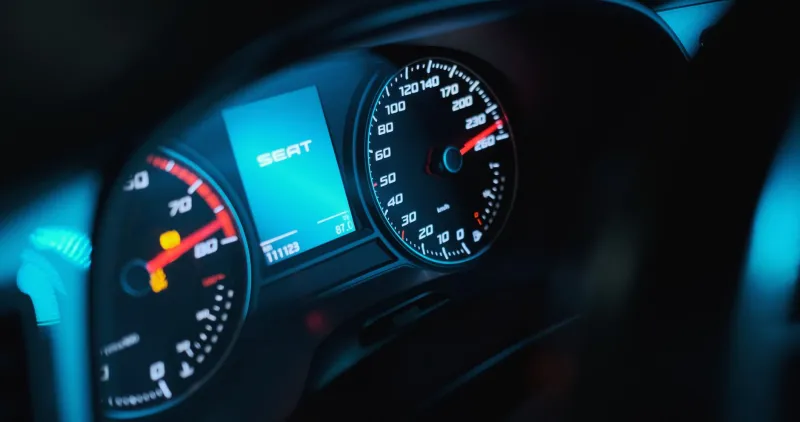
Pull out of your driveway after dark and your instrument panel does something you've probably never consciously noticed: it glows at you in a way that doesn't wreck your ability to see the road ahead. The numbers are readable. The gauges are visible. But your eyes don't have to reset every time you glance down. That balance — useful illumination without visual disruption — didn't come from an automotive designer. It came from a problem that killed people at 25,000 feet.
The Night Vision Problem Nobody Talks About
Human eyes have two main types of photoreceptors: cones, which handle color and detail in bright light, and rods, which take over in low-light conditions. The catch is that rods are almost completely blind to red light. They also take roughly 20 to 30 minutes of darkness to reach full sensitivity — a process called dark adaptation.
For a driver or a pilot operating at night, this creates a real tension. You need enough light to read your instruments. But every time a bright light hits your eyes, it partially resets that dark adaptation. Your rods take time to recover. In the seconds it takes to readjust, you're flying or driving on degraded vision.
In a car doing 60 mph on a dark highway, that's a meaningful fraction of a second where you're operating blind. In a fighter aircraft over occupied Europe in 1943, it was potentially fatal.
What the Air Force Figured Out Over Germany
American and British military aviation researchers spent considerable effort during World War II studying how pilots could read their instruments at night without compromising their ability to see outside the cockpit — to spot enemy aircraft, identify terrain, or line up a bombing run in near-total darkness.
The answer they landed on was red. Because rods are insensitive to red wavelengths, illuminating cockpit instruments in red allowed pilots to read their gauges while preserving the dark adaptation that made night vision possible. It wasn't a perfect solution — red light makes some colors hard to distinguish, which created its own challenges — but it was a workable one. Military cockpits in the 1940s were bathed in low-intensity red instrument lighting as a direct result of this research.
The principle spread quickly through aviation. By the end of the war, it was standard practice across most Allied air forces, and the reasoning was well-documented in military technical literature.
The Transfer Across Industries
After the war, a generation of engineers who'd spent years solving aviation problems moved into the consumer industries that were booming across postwar America. The automotive sector was particularly hungry for talent — car sales were exploding, vehicles were getting faster, and the roads were filling up with drivers who'd never had to think much about instrument visibility.
The logic translated almost directly. A driver at night faces essentially the same core problem as a pilot: they need to read gauges without torching their ability to see the dark environment around them. Red and amber instrument lighting began appearing in American cars through the 1950s, partly through direct borrowing from aviation practice, partly through independent research that arrived at the same conclusions.
Early American automobiles had used white or pale yellow lighting behind their gauges — functional enough in daytime or in brightly lit urban environments, but harsh on the eyes during nighttime highway driving. The shift toward warmer, lower-intensity illumination wasn't just aesthetic. It was grounded in the same photoreceptor science that had kept bomber pilots alive over the Pacific.
The Green Complication
Here's where the story gets a little messier, because if you look at a modern dashboard, you're probably not seeing pure red. You're seeing green. Or amber. Or some combination depending on the manufacturer and the era.
The shift toward green instrument lighting — which became widespread in American cars from the 1970s onward — was driven by a few factors that pushed back against the strict wartime logic. Green sits near the peak sensitivity of human cone vision under dim conditions, meaning it reads as brighter at lower power levels. That matters for energy efficiency. It also turns out that green is easier for most people to read quickly, particularly for numerical displays.
Military aviation eventually followed a similar path, with modern cockpits using a mix of green and white night-vision compatible displays rather than the pure red of the 1940s. The science evolved. But the underlying principle — that instrument lighting needs to be engineered around the biology of the human eye, not just around making things visible — came directly from those wartime cockpits.
The LED Twist
Modern LED dashboard technology has made the old constraints partially obsolete. LED systems can be tuned to almost any color and intensity, adjusted dynamically based on ambient light sensors, and dimmed to levels that would have been impossible with older bulb technology. Some high-end vehicles now let drivers choose their own instrument lighting colors entirely.
And yet the defaults that automakers choose — the warm ambers and greens and the careful calibration of brightness — still reflect design principles rooted in research that's 80 years old. The specific technology changed. The human eye didn't.
The Hidden History Behind the Glow
Next time you're driving at night and you glance down at your speedometer without losing your sense of the dark road ahead, you're benefiting from a problem that was solved in a very different context, by engineers who were thinking about survival at altitude rather than commuting comfort.
The soft light behind your gauges has a backstory that runs from a wartime cockpit to a postwar engineering culture to a design choice made before most current drivers were born. It's one of those things that works so well, so quietly, that nobody ever thinks to ask where it came from.