The Secret Sidewalk Language That Accidentally Wrote America's First Travel Guide
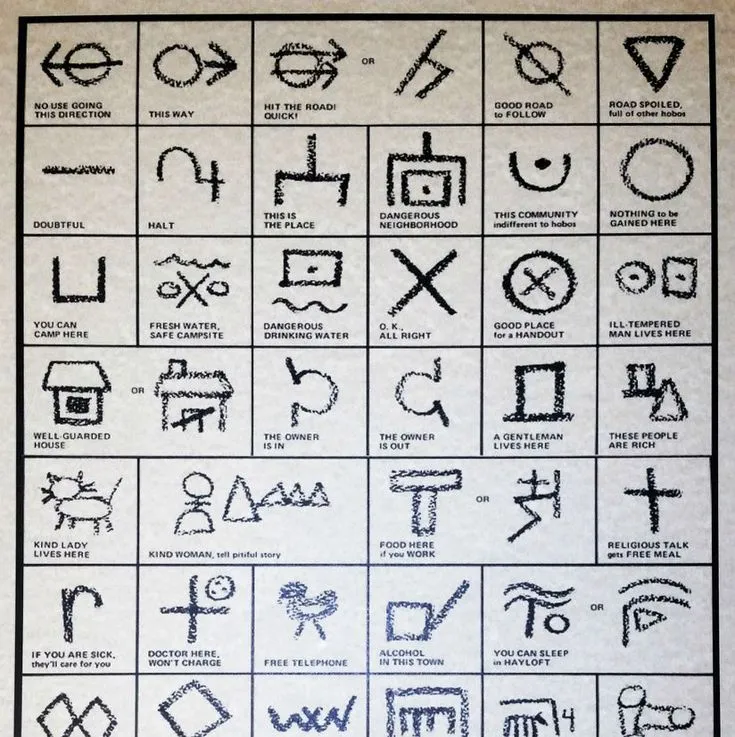
Photo: vintage hobo chalk symbols fence post American road 1930s, via i.pinimg.com
The Secret Sidewalk Language That Accidentally Wrote America's First Travel Guide
You've probably never noticed the small chalk marks scratched onto a fence post or the faded symbols worn into a curbstone. Most people walk right past them. But for a generation of American drifters, hitchhikers, and hobos during the late 19th and early 20th centuries, those marks were the difference between a hot meal and an empty stomach — or between a safe night's sleep and a run-in with a hostile local sheriff.
What those wanderers built, without any intention of doing so, was the United States' first working system of travel intelligence. And the fingerprints of that informal network are all over the road guides, travel apps, and highway rating systems Americans rely on today.
A Language Nobody Taught You
The hobo code — as historians and folklorists eventually came to call it — wasn't invented by any single person. It evolved organically among the large communities of itinerant workers and displaced men who crisscrossed America by foot, rail, and hitched wagon from roughly the 1880s onward. The symbols were simple by design. A circle with two arrows pointing outward meant get out fast. A cat sketch near a doorstep indicated a kind woman lived inside. A triangle with raised hands warned of a dangerous neighborhood. A series of horizontal lines told travelers that a house would offer work in exchange for food.
The genius of the system was its invisibility to outsiders. Most townspeople walked past the marks without registering them. But a traveler who knew the code could walk into an unfamiliar town and immediately begin reading its social geography — which streets were safe, which households were generous, which local lawmen had a reputation for roughing up strangers.
This was, in every functional sense, a crowdsourced review platform. It was just written in chalk instead of pixels.
When the Code Went Commercial
The hobo code remained underground for decades, known only to those who needed it. But by the early 1900s, as automobile ownership began spreading through the American middle class, a different kind of long-distance traveler was emerging — one with money in their pocket and no idea how to plan a multi-day road trip.
Early motorists faced the same core problem the hobos had been solving for years: roads were unreliable, towns were unpredictable, and there was no reliable way to know in advance whether the next stop had gasoline, a decent meal, or a place to sleep.
Entrepreneurs noticed the gap. Small publishing outfits began producing regional road guides in the 1910s, rating towns and roadside stops based on traveler reports. The format — short assessments of specific stops, warning symbols for hazards, recommendations for friendly establishments — borrowed heavily from the same logic the hobo code had pioneered. Whether those early publishers consciously drew on the drifter tradition or simply arrived at the same practical solution independently is hard to say. But the structural resemblance is striking.
The Automobile Blue Book, one of the earliest commercial road guides to gain national traction, organized its information almost exactly the way the hobo code did: by route, with coded symbols indicating road quality, fuel availability, and lodging options. The language had been cleaned up and printed on paper, but the underlying architecture was the same.
 Photo: Automobile Blue Book, via d3vl3jxeh4ou3u.cloudfront.net
The Forgotten Cartographers
What makes this story particularly interesting is who got left out of it. The men and women who built the original system — who tested every road, assessed every household, and maintained the code through decades of use — received none of the credit when their framework went mainstream. Commercial publishers sold their sanitized versions to middle-class motorists. The drifters who had been doing the original fieldwork were simultaneously being pushed off the roads by vagrancy laws and increasing law enforcement pressure.
By the time the first AAA travel guides appeared in the 1920s, the hobo code had been largely erased from public memory. The new road guides were marketed as fresh innovations, products of the modern motoring age. The underground network that had field-tested the concept for forty years wasn't mentioned.
This pattern — of informal community knowledge getting absorbed into commercial products without attribution — would repeat itself throughout American road culture. But the hobo code version is one of the earliest and most complete examples.
Chalk Marks to App Ratings
It's worth pausing on just how modern the hobo code's logic actually was. The system was built on distributed reporting — many travelers contributing small pieces of local knowledge that collectively produced a reliable picture of conditions on the ground. Updates were added constantly as conditions changed. Bad information got corrected when travelers found it inaccurate. Useful stops got reinforced with repeated marks. Dangerous locations accumulated warning symbols over time.
That is, functionally, exactly how Google Maps reviews work. Or Yelp. Or TripAdvisor.
 Photo: Google Maps, via articles-img.sftcdn.net
The interface is different. The scale is incomparably larger. But the underlying model — strangers contributing real-time assessments of places so that other strangers can make better decisions — is identical to what a community of drifters worked out on American roadsides more than a century ago.
Why It Still Matters
The hobo code is worth remembering not just as a historical curiosity but as a reminder that the people who actually use roads — not engineers, not publishers, not app developers — have always been the ones who understand them best. The drifters who scratched symbols onto fence posts weren't trying to disrupt the travel industry. They were just trying to get through the day.
In doing so, they invented something that outlasted them. The specific symbols have faded. The communities that maintained the code are long gone. But the idea that travelers should share what they know with the strangers coming behind them? That's still very much alive — just running on servers now instead of chalk.