Before Big Oil Built the Pumps, the Corner Drugstore Was Selling You Gas
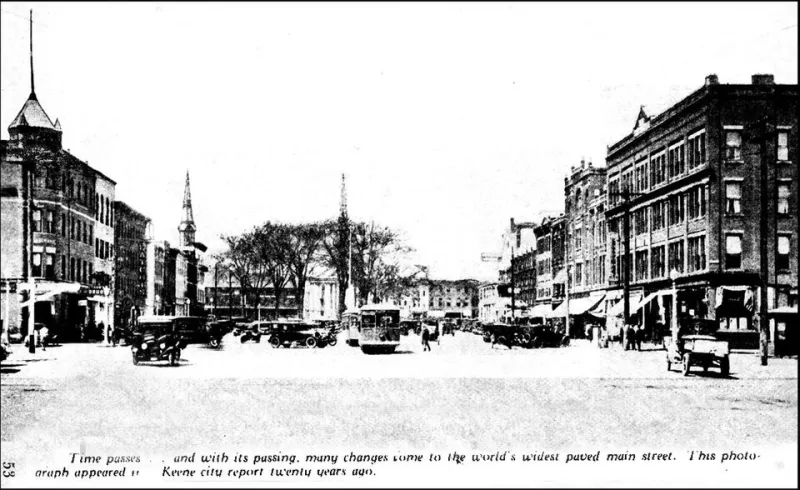
Photo: Keene Public Library and the Historical Society of Cheshire County from USA, No restrictions, via Wikimedia Commons
The next time you pull into a gas station, take a second to look around. The canopy, the pumps, the little convenience store with its coffee and beef jerky — it all feels like it was designed by a corporation with a logo and a five-year plan. And today, mostly, it was.
But the original gas station? That was invented by accident, by small-town merchants who were just trying to beat the guy across the street.
The story of how America got its filling stations is not the story of Standard Oil or Texaco making a strategic decision to build a distribution network. It's the story of a pharmacist in Ohio, a general store owner in Missouri, a hardware merchant in Pittsburgh — all of them scrambling to figure out what to do with the strange new customers rolling up in automobiles and asking where they could buy fuel.
The First Fuel Customers Were a Nuisance
In the early 1900s, gasoline wasn't sold at gas stations. There were no gas stations. If you owned one of the roughly 8,000 automobiles registered in the United States in 1900, you bought your fuel wherever you could find it — which usually meant a general store, a hardware shop, or a pharmacy that also stocked kerosene and lamp oil.
This was awkward for everyone involved. Gasoline was sold from the same barrels used for other petroleum products, measured out by hand into whatever container the customer brought. It was slow, imprecise, and occasionally dangerous — open flame was common in hardware stores, and gasoline vapors are not forgiving of carelessness. More than a few early transactions ended badly.
For the merchants, early automobile owners were a mixed blessing. They bought fuel in unpredictable quantities, often needed help they couldn't provide, and had a habit of asking where the nearest road to the next town was. But they were also cash customers, and by 1905 their numbers were growing fast enough that ignoring them felt like leaving money on the table.
The Drugstore Gambit
The pivotal shift — the moment the gas station started to take shape as a distinct business — happened not through corporate planning but through local competition.
Pharmacies in the early 1900s were already selling a broader range of goods than we'd recognize today. They stocked kerosene, machine oil, rubber goods, and basic hardware alongside patent medicines and prescriptions. When automobile owners started showing up asking for fuel, some pharmacists saw an opportunity that their competitors hadn't noticed yet.
In Mercer County, Ohio, and similar small communities across the Midwest, drugstore owners began positioning barrels of gasoline near their front entrances — a deliberate signal to passing drivers. A few went further, rigging up hand pumps attached to roadside tanks to make the transaction faster and less messy. The goal was simple: if a driver stopped at your store for gas, they might also buy something else.
When the general store across the street noticed customers being pulled away, they did the same thing. Then the hardware merchant. Then the livery stable that was already losing business to automobiles and desperately needed a new revenue stream.
By 1905 or so, in dozens of American small towns, you had competing merchants all selling gasoline from the curb, each one trying to make the process slightly faster or more convenient than the last.
Pittsburgh Gets Serious
The first purpose-built filling station — a location designed specifically and solely to sell fuel to automobiles — is generally credited to a Gulf Refining Company installation in Pittsburgh, Pennsylvania, in December 1913. It had dedicated pumps, a covered canopy to protect drivers from the weather, and an attendant whose entire job was to service cars.
But Gulf didn't invent the concept from scratch. They were formalizing and scaling something that independent merchants had already proven worked. The company had been watching those curb-side operations for years and recognized that the chaotic, hardware-store model wasn't going to survive the volume of cars that was clearly coming.
What Gulf built in Pittsburgh was essentially a clean, corporate version of what the drugstore down the road in Ohio had been doing for a decade. They just did it with a company logo, uniform attendants, and standardized equipment.
Shell, Texaco, and Standard Oil followed within a few years, each building out networks of dedicated stations that pushed the old general-store fuel sellers out of the gasoline business almost entirely by the 1920s.
The Template That Stuck
There's an irony buried in this history. The oil companies that eventually dominated American fueling infrastructure didn't pioneer the customer experience model — they copied it from the small merchants who'd been improvising it for years.
The idea that a gas stop should also be a place to buy other things? That came from the pharmacy owners who used fuel as a foot-traffic driver. The covered canopy? An adaptation of the awning that general stores had used for decades to keep customers comfortable. The friendly attendant who came to your window? A formalization of the general store clerk who helped you carry your barrel to the car.
Even the modern convenience store attached to the gas station — the thing that sells you coffee and chips at 7 a.m. — is a direct descendant of that original drugstore instinct: get them in for the gas, sell them something else while they're there.
The big oil companies built the infrastructure. But the model? That was invented by a bunch of small-town retailers who were just trying to stay competitive on a Saturday afternoon in 1905.