Why Your Car Has Five Lug Nuts — And Why That Number Makes Almost No Sense
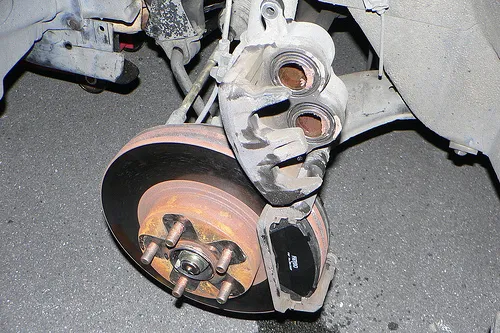
Photo: Awojtas, Public domain, via Wikimedia Commons
Pull up to any tire shop in America and watch what happens when a wheel comes off. The technician pulls five lug nuts, swaps the tire, puts five lug nuts back. Nobody questions it. Nobody has ever really questioned it. But spend five minutes with an engineer and a whiteboard and a simple truth emerges: five is a genuinely weird number for this application, and the reason it became standard is a story built almost entirely on accident, inertia, and the peculiar logic of mass manufacturing.
The Problem With Five (That Nobody Talks About)
Let's start with the math, because the math is where things get interesting.
When engineers design a fastening pattern — bolts holding a flange, screws securing a panel — they generally prefer even numbers. Four bolts, six bolts, eight bolts. The reason is simple: even numbers allow for perfectly symmetrical load distribution, and they make installation easier because each fastener sits directly opposite another. You can torque them in balanced pairs, alternating across the center, and the load spreads cleanly.
Five doesn't do that. With five lug nuts, no fastener sits directly across from another. The load distribution is still acceptable — engineers worked that out — but it requires a specific star-pattern tightening sequence to avoid warping the rotor. It's not dangerous when done correctly, but it's more finicky than a four or six-bolt pattern, and it's produced generations of roadside frustrations when drivers trying to swap a spare in the dark can't remember which order to tighten things.
So why five?
The Early Days: When Nobody Agreed on Anything
In the first decade of American automobile manufacturing — roughly 1900 to 1915 — there was no standard for much of anything. Wheel attachment systems varied wildly between manufacturers. Some early cars used three bolts. Some used four. A few European designs experimented with six. The Ford Model T, which arrived in 1908 and eventually became the template for mass-market American cars, used a different lug pattern than most of its competitors.
The chaos wasn't just inconvenient — it was commercially damaging. Tire manufacturers couldn't design universal products. Repair shops had to stock multiple sets of tools. The growing network of roadside mechanics was drowning in incompatible hardware.
By the mid-1910s, there was genuine industry pressure to standardize. The Society of Automotive Engineers — the SAE, which still sets standards today — began pushing manufacturers toward common specifications. The question wasn't just how many lugs, but what bolt circle diameter, what thread pitch, what seat angle. It was a negotiation between competing engineering philosophies and competing business interests.
The Compromise That Stuck
Here's where the story gets murky in the way that a lot of industrial history does: there's no single dramatic moment, no lone inventor, no patent filing that explains why five became the number.
What historians and automotive engineers generally agree on is this: five lug nuts emerged from a manufacturing compromise in the late 1910s and early 1920s, when American automakers were scaling up to levels of production that nobody had ever attempted before. At those volumes, small differences in material cost and machining time mattered enormously.
A five-bolt hub used slightly less material than a six-bolt hub. The hub itself could be smaller and lighter, which mattered for unsprung weight — the weight of components not supported by the suspension, which affects handling and ride quality. At the same time, five bolts provided meaningfully more clamping force and redundancy than four, which was becoming a concern as cars got heavier and faster.
Five was, in the language of engineering, a local optimum. Not the best theoretical solution, but the best practical solution given the constraints of the moment. And once enough manufacturers settled on it, the economics of standardization kicked in. Tire manufacturers, wheel manufacturers, and tool manufacturers all built their products around five lugs. Changing the number would have meant retooling an entire supply chain.
The Exceptions That Prove the Rule
Not everyone went to five, and the exceptions are revealing.
Heavy-duty trucks and commercial vehicles have used six, eight, or even ten lug nuts for decades — because the loads they carry are genuinely different, and the engineering math works out differently at that scale. Some European performance cars, particularly older Porsches and certain Mercedes models, famously used a single large center-lock nut instead of multiple smaller ones, a design borrowed directly from racing that allowed for faster wheel changes but required a specialized socket the size of a small dinner plate.
In motorsport, four-lug and even three-lug patterns appear on lightweight racing applications where reducing rotational mass matters more than redundancy. Formula 1 cars use a single center-lock nut that can be removed in under two seconds by a pneumatic gun.
But for the American passenger car market, five became the default and stayed the default through nearly a century of engineering evolution.
Why It's Not Changing Anytime Soon
Every few years, someone in the automotive press floats the idea that modern cars should move to a six-lug pattern for better load distribution, or four lugs for weight savings, or some entirely new fastening system. And every time, the same answer comes back from the industry: the cost of transition is prohibitive.
It's not just about redesigning hubs and wheels. It's about the aftermarket — the billions of dollars of existing wheels, tires, and tools already in circulation. It's about the muscle memory of every mechanic in every shop in America. It's about liability and certification and the slow-moving machinery of automotive standards.
The five-lug nut is a perfect example of what engineers call path dependence — the idea that where you end up is determined not just by what's optimal, but by the specific sequence of decisions that got you there. A hundred years ago, a group of manufacturers made a practical compromise under pressure. Today, that compromise is so deeply embedded in the infrastructure of American driving that changing it would cost more than it could possibly save.
So next time you're kneeling on the shoulder of I-95 at midnight, trying to remember whether you tighten lug nuts in a star pattern or a circle, you can blame a production decision from the Harding administration. And the fact that no one's fixed it since then says everything about how the auto industry really works.