Tiller, Joystick, or Wheel: The Forgotten Design War That Shaped Every Car Ever Built
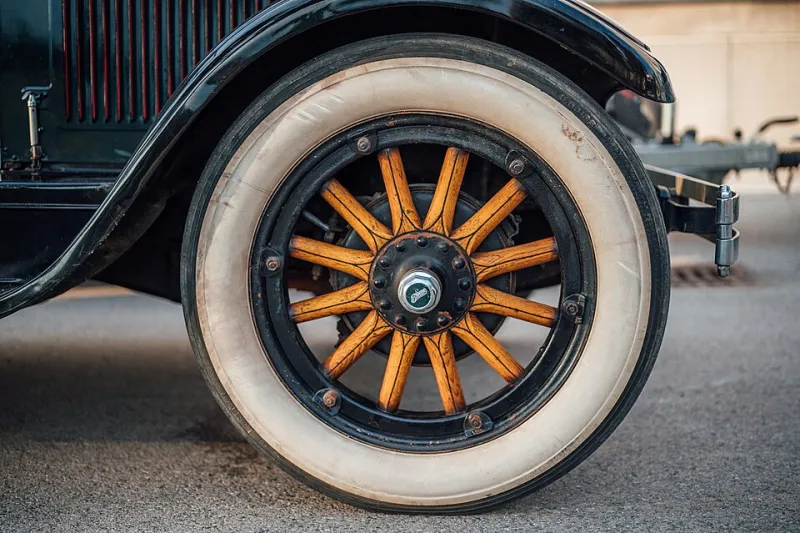
Photo: Ivan Radic, CC BY 2.0, via Wikimedia Commons
Every driver in America sits behind a circular wheel. Every simulator, every video game, every movie car chase takes it as a given. The steering wheel feels so natural, so inevitable, that imagining any other arrangement seems almost absurd. But spend an afternoon in the early automotive archives and a different picture emerges — one where the wheel was a late entrant in a genuine competition, where engineers argued passionately for alternatives, and where the outcome hinged on a handful of accidents and one manufacturer's obsession with simplicity.
The steering wheel wasn't destiny. It was a decision. And it almost went the other way.
Before the Wheel: The Tiller Era
The earliest self-propelled road vehicles didn't use steering wheels at all. They used tillers — essentially the same lever system that had been steering boats for centuries. It made perfect sense at the time. Early automotive engineers were adapting technology they already understood, and the tiller was a known quantity. Push it left, the front wheels go right. Pull it right, the front wheels go left. Simple, direct, mechanical.
The Benz Patent-Motorwagen of 1885, widely recognized as the first true automobile, used a tiller. The early Duryea cars that puttered around Springfield, Massachusetts in the 1890s used tillers. The first vehicles that wobbled down American roads in the hands of bewildered early adopters were almost universally tiller-steered.
But the tiller had a problem that became obvious the moment cars got faster: it was exhausting and counterintuitive at speed. The faster you went, the more the tiller wanted to kick back against bumps and ruts in the road. Drivers had to fight it constantly. And the reversed-input logic — push left to go right — created dangerous hesitation moments in emergency situations. Drivers who'd been riding horses their whole lives found themselves instinctively pulling the wrong direction at the worst possible times.
By the late 1890s, the tiller was already on borrowed time. The question was what would replace it.
The Wheel Arrives — But So Does the Joystick
The steering wheel's first recorded appearance on an automobile is generally credited to Alfred Vacheron, a French racing driver who modified his Panhard vehicle with a wheel for the 1894 Paris-Rouen race. The wheel offered something the tiller couldn't: a continuous range of fine adjustments, a more natural grip, and — crucially — a more intuitive connection between hand movement and vehicle direction. Turn the wheel left, the car goes left. The logic matched human instinct in a way the tiller never had.
But the wheel wasn't the only challenger. A faction of engineers, particularly in Europe and in some American experimental workshops, was pushing for a different solution entirely: a vertical lever system that operated more like what we'd now call a joystick. The argument for this design was compelling. A joystick could theoretically handle both steering and speed modulation in a single control, reducing the cognitive load on the driver. Some prototypes allowed the lever to be pushed forward to accelerate and pulled back to brake, while side-to-side movement handled direction. One control. Everything in one hand.
It was elegant. It was logical. And for a few years in the early 1900s, it had serious advocates.
The Crash That Changed the Argument
The joystick's moment of crisis came through a combination of incidents that, individually, might have been dismissed as driver error. Collectively, they revealed a fatal flaw.
Several prototype joystick-controlled vehicles, tested in both Europe and the United States during the early 1900s, experienced accidents rooted in the same basic problem: in a moment of sudden panic, drivers gripped the joystick and held on. The instinct to brace yourself against a frightening situation — the same instinct that makes you grab a railing when you're startled — caused drivers to lock the joystick in whatever position it was in at the moment of fright. If that position was mid-turn, the car continued turning. If it was mid-brake, the car stopped abruptly. The control system punished the most natural human fear response.
A steering wheel, by contrast, was relatively forgiving of the white-knuckle grip. Grabbing a wheel tightly and holding it didn't necessarily make things worse — and the circular shape meant that even a panicking driver's hands tended to slide rather than lock.
The accidents weren't catastrophic by later standards, but the pattern was clear to anyone paying attention. And by the mid-1900s, the joystick advocates were losing the argument.
Ford Makes It Final
If the joystick's mechanical problems were the first nail in its coffin, Henry Ford's manufacturing philosophy was the second — and the one that sealed it permanently.
When Ford began developing what would become the Model T in the mid-1900s, he was obsessed with a single goal: producing a car that could be built identically, repeatedly, and cheaply enough that ordinary Americans could afford it. Every component had to be simple to manufacture, simple to install, and simple to operate. The wheel, by 1908, had already accumulated several years of real-world data suggesting it was the safest and most intuitive steering interface available. It was also mechanically simpler to connect to a steering column than the more complex linkage required by a joystick or tiller.
The Model T used a steering wheel. The Model T sold fifteen million units. And when fifteen million Americans learned to drive on a steering wheel, the question of what cars should use was effectively answered by the market before any regulatory body had a chance to weigh in.
The Long Shadow of That Decision
Every car built since then — every truck, every bus, every tractor, every go-kart — has inherited that choice. The steering wheel became so universal that it shaped the entire physical architecture of the car around it: the position of the driver, the layout of the dashboard, the ergonomics of the seat. When manufacturers began electrifying and automating vehicles in the twenty-first century, the steering wheel was the last thing to go — and in most autonomous vehicle concepts, it's still there, even when the car doesn't technically need it, because removing it makes passengers deeply uncomfortable.
We've built a century of muscle memory, regulation, and infrastructure around a circle of metal and leather. Joystick advocates still exist — some modern aviation-inspired concepts have revisited the idea — but they're working against a current so strong that it might as well be gravity.
The wheel won not because it was perfect, but because it was good enough at exactly the right moment, with exactly the right manufacturer behind it. That's how a lot of history works. The best idea doesn't always win. The idea that's standing closest to the assembly line when the decision gets made — that's the one you're still living with today.