The Brilliant Engineer Who Solved Night Blindness But Had to Wait 40 Years to Save Lives
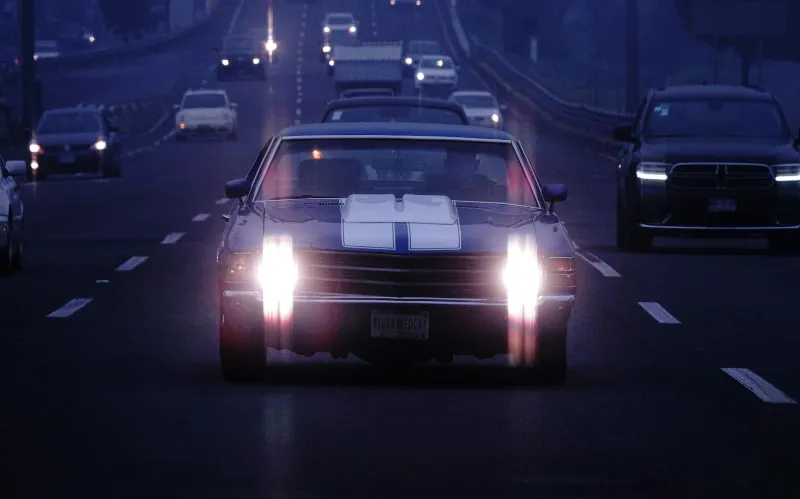
Every night, millions of Americans navigate dark highways with a confidence their grandparents never could have imagined. When oncoming headlights approach, there's no temporary blindness, no white-knuckle moments of hoping you're still in your lane. Yet this basic safety feature — anti-glare headlight technology — took nearly half a century to become standard, despite being invented and perfected multiple times along the way.
The Problem Everyone Knew About
By the 1930s, as car ownership exploded across America, nighttime driving had become a genuine public health crisis. Drivers routinely described being "snow-blinded" by oncoming headlights, forced to slow to a crawl or pull over entirely until their vision returned. Accident rates after dark were astronomical compared to daytime driving, and everyone knew why.
The issue wasn't just brightness — it was the harsh, unfiltered light that early headlamps threw directly into drivers' eyes. Unlike today's carefully engineered beam patterns, early headlights were essentially searchlights bolted to the front of cars. Meeting another vehicle at night meant several seconds of near-total blindness for both drivers.
The Solution That Came Too Soon
In 1936, a General Electric engineer named Charles Kettering cracked the problem. His solution was elegantly simple: asymmetrical headlight beams that illuminated the road ahead while directing light away from oncoming drivers' eyes. Kettering's "sealed beam" headlights used precisely angled reflectors and carefully positioned filaments to create what he called "seeing light" instead of "blinding light."
The technology worked flawlessly in tests. European automakers quickly adopted similar systems. But in America, Kettering's innovation hit an unexpected wall: the automotive industry itself.
The Forty-Year Stall
Automakers in the 1930s were locked in fierce competition over styling and features, but headlights weren't seen as a selling point. More problematically, standardizing anti-glare technology would require coordination between manufacturers, suppliers, and regulators — exactly the kind of industry-wide cooperation that Detroit's competitive culture resisted.
The real roadblock came from an unexpected source: state regulations. Individual states controlled vehicle lighting standards, creating a patchwork of conflicting requirements. A headlight legal in Michigan might be banned in Ohio. Rather than navigate this regulatory maze, most manufacturers simply stuck with the cheapest, most basic lighting that met the lowest common denominator.
Meanwhile, inventors kept solving the same problem over and over. In 1940, a Detroit engineer named Robert Bosch perfected a different anti-glare approach using polarized filters. In 1952, a team at Westinghouse created yet another solution using precisely controlled beam cutoffs. Each innovation worked, each was patented, and each was quietly shelved.
The Breakthrough That Almost Wasn't
The real change came from an unlikely source: a small-town doctor in Indiana named Claire Straith. After treating his hundredth nighttime collision victim in 1954, Straith began lobbying state legislators with a simple argument: if the technology to prevent these crashes existed, why weren't we using it?
Straith's medical credentials gave him credibility that engineers and inventors lacked. He testified before state transportation committees, armed with accident statistics and photos of crash victims. More importantly, he made the case that anti-glare headlights weren't just a convenience feature — they were a public health necessity.
The Federal Solution
By the early 1960s, enough states had adopted conflicting anti-glare requirements that the automotive industry faced exactly what it had tried to avoid: a regulatory nightmare. Different beam patterns were required in different markets, making manufacturing increasingly complex and expensive.
The solution came through federal intervention. The 1966 National Traffic and Motor Vehicle Safety Act gave Washington the power to establish uniform lighting standards. Rather than fight a patchwork of state regulations, automakers could finally work with a single set of requirements.
The first federally mandated anti-glare headlight standards took effect in 1968 — thirty-two years after Kettering's original invention.
Why It Mattered
The impact was immediate and dramatic. Nighttime accident rates dropped by nearly 30% within two years of implementation. Drivers reported feeling confident on dark highways for the first time. The technology that had existed for decades finally reached the people who needed it.
Today's adaptive headlight systems — which automatically adjust beam patterns based on steering input, vehicle speed, and oncoming traffic — represent the culmination of engineering work that began in the 1930s. The basic principle Kettering identified remains unchanged: light the road, not the driver.
The story of anti-glare headlights reveals how the best engineering solutions mean nothing without the right regulatory and economic conditions. Sometimes the biggest obstacle to innovation isn't the technology — it's everything else.