Why Some Cops Drive Black and White — And Why Others Never Would
Photo: don cload , CC BY-SA 2.0, via Wikimedia Commons
If you grew up watching American television, the black-and-white police car is essentially hardwired into your brain as the universal symbol of law enforcement. The two-tone cruiser. The rolling contrast. The car that needs no markings because everyone already knows what it is.
But spend five minutes looking at police vehicles across different American cities and states, and the picture gets complicated fast. Texas Highway Patrol drives solid white. Massachusetts State Police runs dark blue. Georgia State Patrol uses a silver and black scheme. And in some jurisdictions, the cars are so unmarked that you'd never recognize them as police vehicles at all.
The black-and-white wasn't inevitable. It was a choice — and the story of who made it, who rejected it, and why reveals something surprisingly layered about how American communities have always wanted their police to be perceived.
Los Angeles Made the Call
The black-and-white police car as a deliberate design strategy traces most directly to Los Angeles in the 1920s. The LAPD, dealing with a rapidly expanding city and a growing fleet of patrol vehicles, needed a way to make police cars instantly recognizable at a distance. The solution they landed on drew from a principle that military aviation had been developing for years: high-contrast two-tone paint schemes make objects immediately identifiable, even in peripheral vision, even at speed.
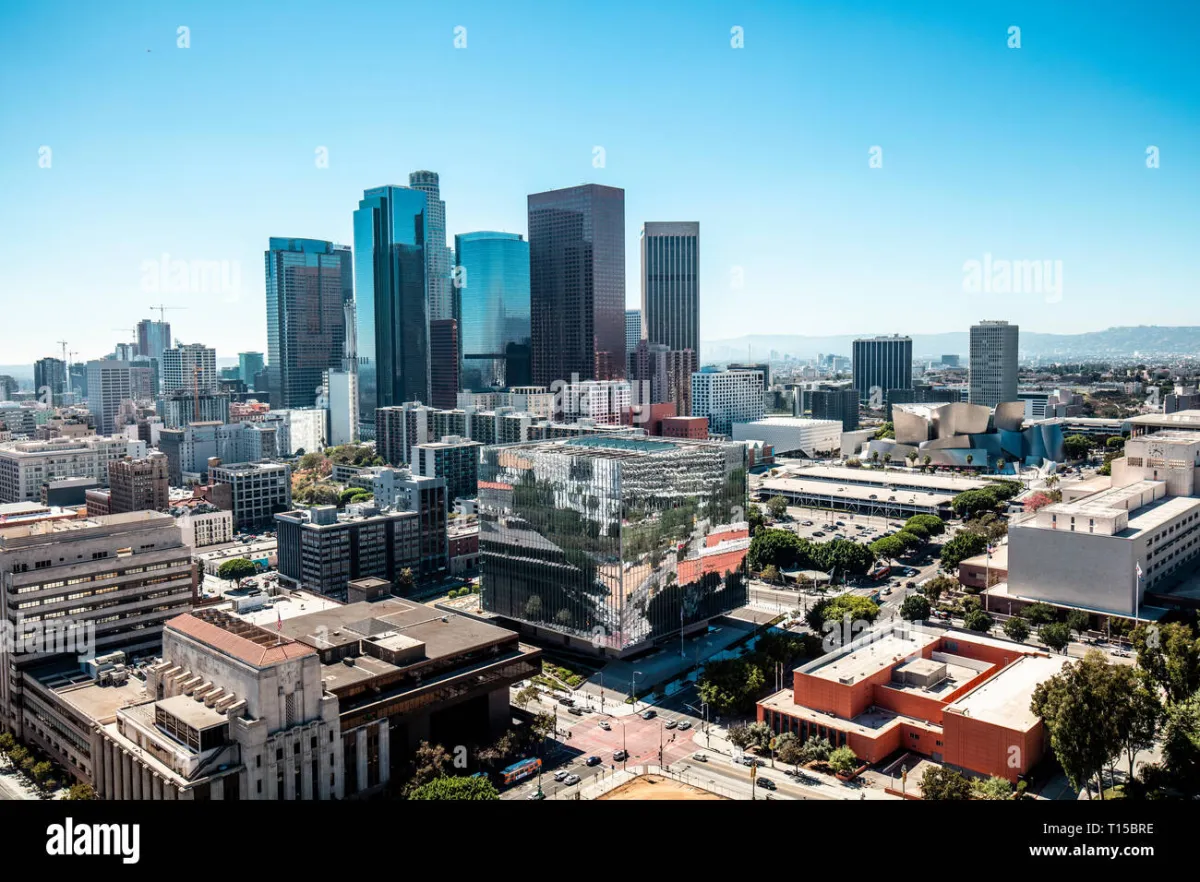 Photo: Los Angeles, via c8.alamy.com
The logic was straightforward. A solid-colored car blends into its environment. A two-tone car — especially one using the maximum contrast available, which is black and white — jumps out of any visual field. Criminals would see it coming. Citizens in distress would spot it easily. The car itself would become a deterrent and a beacon simultaneously.
The LAPD adopted the black-and-white scheme formally, and it stuck. As Los Angeles grew into one of the most influential cities in American culture through the mid-twentieth century, its police aesthetic traveled with it — through Hollywood films, television dramas, and the general cultural export machine that California ran so effectively.
The Visibility Argument
The two-tone approach had genuine practical support beyond the LAPD's experience. Traffic safety researchers through the 1950s and 1960s began studying police vehicle visibility, and the findings generally supported high-contrast schemes. Studies showed that drivers recognized two-tone vehicles faster than solid-colored ones, particularly in low-light conditions.
This research reinforced what Los Angeles had figured out empirically: a car that's easy to see is a car that changes behavior. If drivers slow down when they spot a police cruiser, and they spot it faster when it's black and white, then the paint job is doing law enforcement work even when the officer inside isn't.
For departments trying to stretch limited resources, that passive deterrence effect had real value. One visible patrol car covering a stretch of highway could suppress speeding across a much wider area than a less recognizable vehicle. The color scheme was, in a sense, a force multiplier.
The Resistance
So why didn't everyone go along with it?
The reasons varied by region, and they weren't always purely practical.
In many southern states, police departments maintained solid-color schemes — often solid black, or solid dark blue — well into the 1970s and beyond. Part of this was institutional conservatism. Police departments don't change their equipment aesthetics lightly, and departments that had been running solid-color vehicles for decades had little incentive to repaint their entire fleet based on what California was doing.
But there was also a different philosophy about what police visibility was supposed to accomplish. The black-and-white argument assumed that maximum visibility was always desirable. Not every department agreed. Some agencies believed that a less conspicuous vehicle was more effective for certain kinds of enforcement — traffic patrol, plainclothes operations, surveillance work. A car that blended in could catch behavior that a highly visible cruiser would simply suppress.
There was also, in some communities, a subtler calculation about authority and presence. A highly visible police vehicle announces itself constantly. It dominates the visual environment. For departments in smaller, more rural communities where police were seen as part of the community fabric rather than a separate enforcement presence, that level of visual assertiveness sometimes felt like the wrong message.
The Symbol Becomes Loaded
By the time American policing entered the turbulent decades of the 1960s and 1970s, the black-and-white cruiser had accumulated meaning beyond its original visibility rationale.
In cities like Los Angeles and Chicago, where the black-and-white was firmly established, the car had become a symbol of police authority in a period when that authority was being intensely contested. The two-tone cruiser appeared in civil rights confrontations, in anti-war demonstrations, in urban unrest. Its high visibility — originally a practical asset — made it a powerful visual presence in photographs and news footage that defined an era.
Departments in communities with different relationships to policing sometimes saw those images and made deliberate choices to differentiate themselves. A solid-blue or solid-white cruiser carried different associations. It looked, in some contexts, less militarized. Less like the cars that had appeared in the photographs.
The paint job had become a statement about policing philosophy, whether departments intended it to or not.
Where Things Stand Now
Today, American police vehicle color schemes are as varied as the jurisdictions that deploy them. The LAPD still runs black and white. The NYPD runs blue and white. State police across the country use everything from solid black to silver to tan, often with elaborate graphic treatments that have replaced the simple two-tone logic of earlier eras.
Reflective striping, fluorescent panels, and LED lighting technology have largely supplanted paint color as the primary visibility tool for modern law enforcement vehicles. A car with a full reflective stripe kit is visible at night regardless of its base color, which has freed departments from the original constraint that made two-tone schemes so attractive in the first place.
But the black-and-white persists wherever it persists partly because of what it means, not just what it does. It's the police car of central casting. The one that reads as police before you've processed any other detail.
That kind of instant recognition was exactly what Los Angeles was after in the 1920s. They just didn't anticipate how much weight a paint job could eventually carry.