The Man Who Kept America Pumping: How One Detroit Engineer's Crusade Saved Full-Service Gas Stations
The Technology That Waited Fifty Years
In 1947, Frank Urich invented a gas pump that would let customers fill their own tanks safely and efficiently. The technology worked perfectly. Oil companies tested it successfully. Customers liked the convenience and lower prices. Yet for the next three decades, most Americans never got to use Urich's invention—not because it didn't work, but because one man made it his personal mission to keep gas station attendants employed.
That man was George Tokheim, a Detroit automotive engineer whose family had been building gas pumps since the 1900s. What started as protecting his business model became a nationwide crusade that shaped how Americans bought gasoline for half a century.
The Original Full-Service Experience
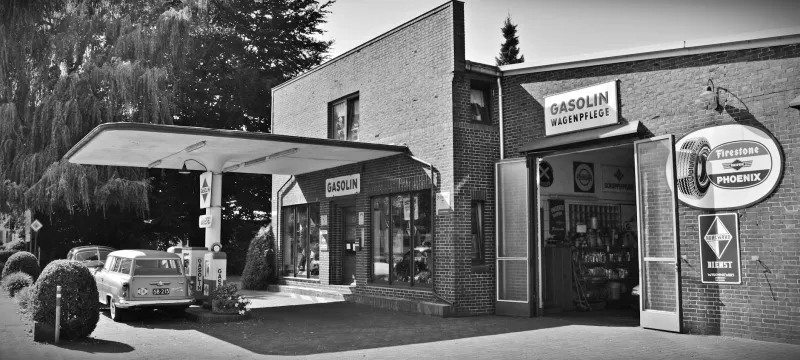
In the 1950s, pulling into a gas station meant instant service. Uniformed attendants rushed to your car, filled your tank, checked your oil, cleaned your windshield, and inspected your tire pressure—all included in the price of gas. It was theater as much as service, with stations competing on the quality of their customer experience.
Tokheim's family company, Tokheim Corporation, supplied the pumps for this elaborate dance. But they also understood that self-service technology could eliminate thousands of jobs overnight. When Urich's patents became available, Tokheim didn't just buy them—he buried them.
The Campaign Against Self-Service
Tokheim launched what he called the "Quality Service Campaign" in 1952. His argument wasn't just about jobs—it was about safety, customer service, and American values. Self-service gas stations, he claimed, would lead to more fires, fuel spills, and accidents as untrained customers handled dangerous equipment.
He funded studies showing higher accident rates at self-service stations (most of which were poorly designed early experiments). He lobbied state legislators, arguing that self-service gas violated consumer protection laws. Most effectively, he allied with labor unions, turning gas station attendants into a powerful political constituency.
By 1968, Tokheim's campaign had convinced eight states to ban self-service gas stations entirely. New Jersey and Oregon passed laws requiring attendants at every pump. Massachusetts, Connecticut, and several other states created regulations so complex that self-service became impractical.
The Economics of Resistance
What made Tokheim's campaign so effective wasn't just politics—it was economics. Full-service gas stations employed nearly 500,000 Americans by 1970. In small towns, the local gas station was often one of the largest employers. Politicians who supported self-service risked being labeled as job killers.
Oil companies played both sides. Publicly, they supported full-service stations and the jobs they created. Privately, they were calculating how much money they could save with self-service. The labor costs were enormous—a busy station might employ six or eight attendants working in shifts.
But Tokheim had convinced them that American consumers weren't ready for the change. His market research showed that customers associated self-service with discount stores and corner-cutting. Premium gasoline brands couldn't risk cheapening their image.
The Cracks in the System
The 1973 oil crisis changed everything. When gas prices doubled overnight, customers suddenly cared more about saving money than getting their windshields cleaned. Independent station owners, struggling with higher wholesale costs, began quietly offering self-service discounts despite state regulations.
Tokheim fought back with a new argument: self-service gas stations were unsafe during an energy crisis because desperate customers might cause accidents or fires. He funded additional safety studies and lobbied for federal intervention.
But the economics had shifted too dramatically. Gas station owners were going bankrupt trying to maintain full-service operations with $1.50 gasoline. Something had to give.
The Revolution Finally Arrives
The breakthrough came from an unexpected source: suburban convenience stores. Companies like 7-Eleven and Circle K began adding gas pumps to their parking lots, offering self-service as part of a broader retail experience. Customers could pump their own gas and buy snacks, coffee, or groceries in one stop.
This wasn't the grimy, unsafe self-service that Tokheim had been fighting—it was clean, well-lit, and convenient. More importantly, it was clearly cheaper. The price difference between full-service and self-service gasoline reached 15 cents per gallon in some markets.
By 1982, self-service stations were pumping more gasoline than full-service stations nationwide. Tokheim's fifty-year campaign was finally losing.
The Holdouts
Tokheim died in 1984, but his legacy lived on in the state laws his campaign had created. New Jersey and Oregon still require gas station attendants today, making them the last bastions of full-service gasoline in America.
These laws have created their own culture. New Jersey residents often feel anxious when they have to pump their own gas while traveling. Oregon drivers sometimes sit in their cars waiting for attendants who aren't coming when they cross state lines.
The safety arguments that Tokheim championed have largely been disproven—self-service gas stations have excellent safety records. But the job protection arguments remain politically powerful. Both states have defeated multiple attempts to legalize self-service, often by wide margins.
The Unintended Legacy
George Tokheim set out to protect gas station jobs and succeeded far beyond what anyone thought possible. His campaign delayed the self-service revolution by decades and permanently changed how two states buy gasoline.
But he also created something unexpected: a baseline of customer service that influenced American retail for generations. The idea that businesses should provide comprehensive service, even for routine transactions, became embedded in American consumer expectations.
Today's gas stations offer far more than fuel—they're convenience stores, restaurants, and service centers. That evolution might have happened anyway, but Tokheim's insistence on maintaining service standards helped establish the template.
Every time you pump your own gas (or sit in your car while someone else does it), you're experiencing the long tail of one Detroit engineer's successful campaign to keep Americans from doing it themselves. Sometimes the most powerful innovations are the ones that almost didn't happen at all.