The Penny Wars That Built America's Highway Landscape
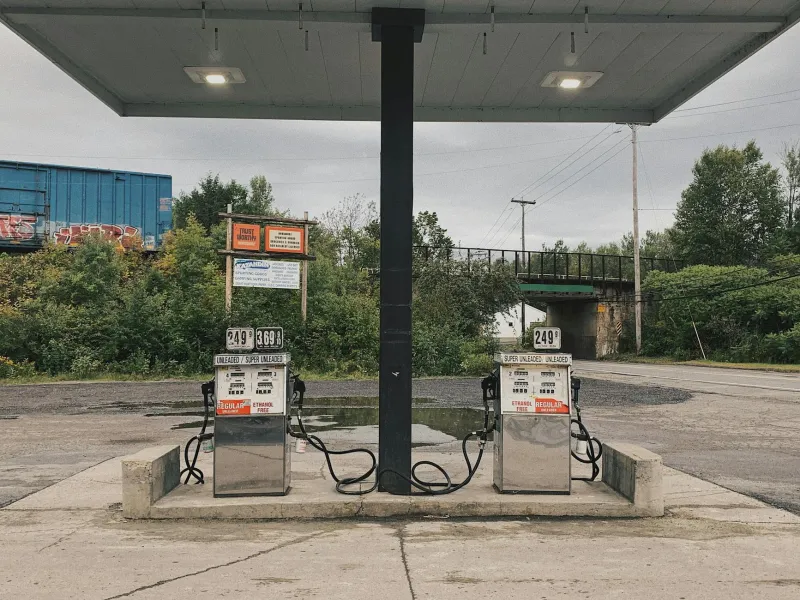
Drive down any American highway and you'll see them: towering price signs announcing gas costs to drivers still blocks away. These monuments to competition are so universal, so embedded in our landscape, that they seem as natural as traffic lights or stop signs. But unlike most highway infrastructure, these signs weren't designed by planners or mandated by regulations. They're the accidental result of the most ruthless price wars in American retail history.
When Gas Stations Battled Block by Block
In the 1950s and 60s, as America's car culture exploded, gas stations multiplied like weeds. Every major intersection seemed to sprout competing stations on opposite corners, each desperate for the same stream of customers. Unlike today's corporate-controlled pricing, individual station owners set their own prices and changed them multiple times per day based on what their competitors across the street were charging.
The competition was vicious and immediate. A station owner might arrive at work to find his rival had undercut him by two cents overnight. By lunch, he'd respond by dropping his price three cents. By evening, both stations might be selling gas at a loss, hoping to make up the difference in cigarette and soda sales.
This wasn't just business rivalry — it was psychological warfare conducted with numbers and cents.
The Birth of Roadside Theater
The first gas price displays were modest affairs: small signs that drivers had to slow down to read. But as competition intensified, station owners realized that visibility meant everything. The earlier a driver could see your price, the more likely they were to choose your station over the competitor's.
What followed was an arms race of visibility. Signs got bigger, taller, and more elaborate. Station owners hired local sign makers to build increasingly dramatic displays, each trying to catch drivers' attention from farther away than their rivals could manage.
By the early 1960s, some price signs had grown to billboard size, towering over their modest stations like ancient monuments. The tail was wagging the dog — tiny gas stations were building massive signs that cost more than some of their buildings.
The Science of the Tenth of a Cent
The most peculiar aspect of these price wars wasn't their intensity — it was their precision. Station owners discovered that even tiny price differences could swing customer behavior dramatically. A difference of one-tenth of a cent per gallon could determine whether a station thrived or went bankrupt.
This led to the strangest feature of American gas pricing: the persistent nine-tenths of a cent that appears on every price sign. What started as a Depression-era tax has persisted for nearly a century because station owners learned that $2.39⁹ looks significantly cheaper than $2.40 to drivers making split-second decisions at highway speeds.
The psychology was so powerful that stations began changing their prices multiple times per day, adjusting by fractions of cents based on traffic patterns, time of day, and competitor moves. Some owners became obsessed with the ritual, checking rival prices hourly and responding immediately to any change.
When David Fought Goliath with Numbers
The most dramatic price wars often pitted independent station owners against major oil companies. Corporate-owned stations had deeper pockets, but independent owners had something more powerful: desperation and flexibility. They could change prices instantly, while corporate stations needed approval from regional offices.
In 1965, a legendary price war erupted in Los Angeles when an independent station owner named Mike Parisian decided to challenge every major brand on his stretch of Wilshire Boulevard simultaneously. Starting at dawn, Parisian began undercutting his competitors by a penny per gallon. By noon, he was selling gas for less than he paid for it.
The corporate stations were trapped. They couldn't let an independent undercut them indefinitely, but they also couldn't afford to sell at a loss for weeks. The standoff lasted three months, with prices dropping so low that drivers from across the city made special trips to fill up on Wilshire Boulevard.
Parisian eventually won when two of the corporate stations gave up and closed. His victory became legend among independent station owners nationwide, inspiring similar price wars from coast to coast.
The Unintended Consequences
What nobody anticipated was how these local price wars would reshape the American landscape. As signs grew larger and more elaborate, they began defining the visual character of commercial strips and highway approaches. Cities that had never planned for massive roadside signage suddenly found their skylines dominated by competing price displays.
The signs also changed driving behavior in unexpected ways. Drivers began "price shopping" while driving, comparing options blocks ahead and making route decisions based on fractions of cents. This led to more erratic traffic patterns as drivers switched lanes or changed direction at the last minute to reach cheaper gas.
The Legacy of the Penny Wars
Today's gas pricing is largely controlled by corporate algorithms and regional supply contracts, but the visual infrastructure of those old price wars remains. Every major highway in America is still lined with towering price signs, most now digital displays that can change instantly but still serve the same purpose: catching drivers' attention from as far away as possible.
Modern gas stations spend thousands of dollars on LED signs that can display prices visible from a quarter-mile away — technology that would have seemed magical to the 1960s station owners who started this arms race with hand-painted plywood and ladders.
The next time you're driving down an American highway, look at those price signs differently. They're not just advertising — they're monuments to one of the most intense retail competitions in American history, when desperate station owners accidentally built the visual landscape we now take for granted.