The Strip of Steel That Quietly Stopped a Million Crashes: Inside the Unlikely Story of the Highway Guardrail
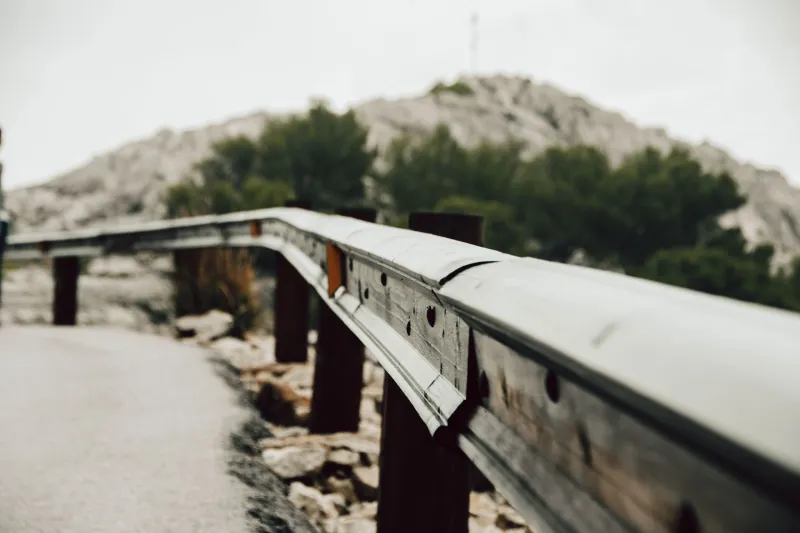
You've driven past thousands of them without a second thought. That corrugated silver ribbon running along the edge of every highway, hugging every mountain curve, standing guard at every bridge approach. It's so common it's practically invisible. But the highway guardrail — that humble, unglamorous strip of bent steel — is one of the most effective pieces of safety engineering ever bolted into American roads. And for a long time, it almost didn't exist at all.
Roads Built for Speed, Not Survival
In the early decades of American driving, road design was primarily about getting cars from one place to another. Safety was an afterthought, if it was a thought at all. Roads were carved through hillsides, stretched across bridges, and threaded along cliff edges with little consideration for what happened when a driver drifted over the line. The answer, most of the time, was that they went over the edge.
Wooden guardrails existed in some places — rough-hewn posts and planks borrowed from farm fencing traditions. But wood split, rotted, and shattered on impact in ways that were sometimes more dangerous than no barrier at all. A car hitting a wooden post at speed could end up with splinters through the windshield and a post through the floorboard. The barriers that were supposed to save lives occasionally made things worse.
By the late 1930s and into the 1940s, as car ownership exploded and highway speeds climbed, roadside fatalities were becoming a genuine national crisis. Pennsylvania, with its rolling hills, steep embankments, and rapidly expanding highway network, was one of the worst-affected states. Engineers there began keeping grim records — cataloguing exactly where cars were leaving the road and what was happening when they did.
The Engineer Who Wouldn't Let It Go
Out of that data came a quiet obsession. Pennsylvania highway engineers, frustrated by the inadequacy of existing barriers, began experimenting with steel. The logic was straightforward: wood broke, but steel bent. A barrier that bent on impact could absorb energy, redirect a sliding vehicle, and — crucially — keep it on the road rather than letting it tumble off a cliff.
The engineering challenge was figuring out what shape that steel should take. A flat sheet was too rigid and would stop a car too abruptly, transferring all the energy back into the vehicle and its occupants. What was needed was a profile that could flex, that could give a little without giving way entirely.
The answer turned out to be a W. The W-beam guardrail — named for the double-wave cross-section that looks, in profile, like a capital W — emerged from testing in the late 1940s as the design that best balanced flexibility with strength. It could deflect a car, slow it gradually, and guide it back onto the road surface rather than stopping it dead or letting it through. It was cheap to manufacture, relatively easy to install, and it worked.
From Experiment to Standard
The Federal Highway Administration began pushing for standardized guardrail installation in the early 1950s, right as the postwar highway boom was reshaping American infrastructure. When Eisenhower signed the Federal Aid Highway Act in 1956, launching the Interstate System, the W-beam guardrail came along for the ride. Miles of new road meant miles of new edge, and every one of those edges needed protection.
 Photo: Interstate System, via lookaside.instagram.com
 Photo: Federal Highway Administration, via drivesafealabama.org
The design was refined over the following decades. Post spacing was adjusted. The height of the beam was standardized. End treatments — the way a guardrail terminates at each end — became a separate engineering problem in their own right, because a guardrail end that speared through a car's windshield was obviously not a solution. The energy-absorbing terminal, developed in the 1970s and 1980s, turned guardrail ends into crumple zones that collapsed on impact rather than impaling whatever hit them.
Each of these refinements came, in part, from the same source as the original design: crash data. Engineers studied what was happening when cars hit barriers, identified where the system was failing, and adjusted accordingly. It was slow, unglamorous work, but the results showed up in the fatality statistics.
A Device Hiding in Plain Sight
Today, the W-beam guardrail is so thoroughly embedded in American road infrastructure that it's essentially invisible. There are hundreds of thousands of miles of it across the country, running along interstates, state highways, rural routes, and mountain roads. Most drivers have never thought about it for more than a fraction of a second.
But transportation safety researchers know exactly what it does. Studies have consistently found that properly installed guardrails reduce fatalities on roads where they're deployed, particularly on curves, embankments, and bridge approaches — exactly the locations where Pennsylvania engineers were watching cars disappear in the 1940s.
The design has barely changed in seventy years. The W-beam profile that came out of postwar testing is still the dominant standard on American highways. There have been updates — stronger steel, better coatings, smarter end terminals — but the fundamental shape, that double wave of bent metal, has outlasted nearly every other piece of highway technology from the same era.
Next time you're cruising down an interstate and you catch that silver ribbon flashing past in your peripheral vision, it's worth a moment of recognition. Someone spent years fighting to put it there. And on more occasions than anyone will ever be able to count, it's been the only thing standing between a momentary mistake and a very permanent outcome.