The Racing Secret That Turned Family Cars Into Mobile Storage Units
When Every Second Counted
In 1923, the first Le Mans 24-hour endurance race introduced a problem that would quietly reshape how every family car was designed: where do you put essential items when you're driving for an entire day without stopping?
 Photo: Le Mans, via i.etsystatic.com
Early race cars were stripped-down machines with no creature comforts, but drivers and mechanics quickly discovered they needed certain items within immediate reach—tools for quick repairs, documents for checkpoint verification, and spare parts that might mean the difference between winning and watching from the sidelines.
The solution was elegantly simple: mechanics began sewing canvas pouches to the backs of racing seats. These primitive pockets held everything from spark plugs to race documentation, positioned where the driver or navigator could grab them without taking eyes off the road or hands off the wheel.
From Track to Factory Floor
Automotive engineers working for major manufacturers often moonlighted as racing consultants, and they couldn't help but notice how practical these seat-back storage solutions were. By the late 1920s, some luxury car manufacturers began incorporating similar features into their most expensive models, marketing them as "touring accessories" for wealthy customers who took long-distance driving trips.
Packard was among the first to offer seat-back pockets as a factory option in 1931, positioning them as sophisticated travel aids for discerning motorists. The pockets were crafted from leather and featured multiple compartments for maps, documents, and personal items. They were expensive, exclusive, and largely ignored by mainstream car buyers.
The feature might have remained a luxury curiosity if not for World War II, which changed everything about automotive design priorities.
War Changes Everything
During WWII, civilian car production stopped, but military vehicle manufacturing exploded. Jeeps, troop transports, and command vehicles all needed storage solutions for equipment, maps, and supplies. Military specifications called for seat-back pockets as standard equipment, not luxury options.
Thousands of American servicemen returned from the war having experienced the practical benefits of organized vehicle storage. When car production resumed in 1945, these veterans represented a significant portion of new car buyers—and they remembered how useful those military vehicle pockets had been.
Manufacturers initially resisted adding seat-back pockets to civilian cars, viewing them as unnecessary complications that added cost without obvious value. But customer demand gradually shifted their perspective, especially as American families began taking longer road trips in the prosperous post-war economy.
The Station Wagon Revolution
The real breakthrough came with the station wagon boom of the 1950s and 60s. These vehicles were specifically designed for families, and families had stuff—lots of stuff that needed to be stored, organized, and accessible during travel.
Chevrolet's 1955 Nomad featured the first mass-market seat-back pockets, marketing them as "family convenience features." The pockets were simple vinyl pouches attached to the rear of front seats, designed to hold children's toys, books, and snacks. The response from buyers was overwhelmingly positive.
 Photo: Chevrolet Nomad, via rajomalovanek.cz
Other manufacturers quickly followed suit, but each company developed its own approach. Ford created deeper pockets with elastic tops to prevent items from falling out during sudden stops. Chrysler added multiple smaller pockets for better organization. American Motors included clear plastic windows so passengers could see contents without rummaging.
The Minivan Makes It Standard
When Chrysler introduced the minivan in 1984, seat-back pockets weren't just included—they were prominently featured in marketing materials as evidence of thoughtful family-focused design. The Plymouth Voyager's pockets were larger and more sophisticated than anything previously offered, with multiple compartments and reinforced stitching.
The minivan's success forced every automaker to reconsider family vehicle features. By the early 1990s, seat-back pockets had become so expected in family vehicles that their absence was considered a design flaw. Parents specifically asked about storage features when shopping for cars, and dealers learned to highlight pockets as selling points.
Evolution and Innovation
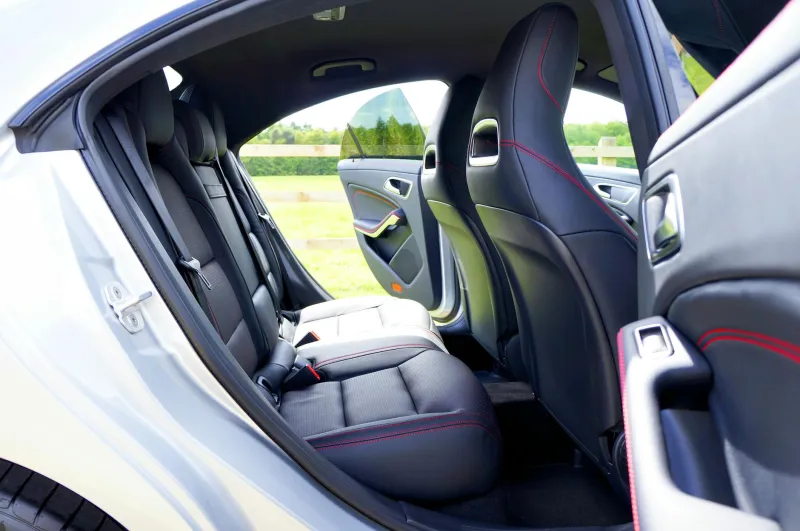
Modern seat-back pockets bear little resemblance to their racing origins, but the core function remains identical: keeping essential items within easy reach. Today's versions might include cup holders, tablet slots, charging ports, and even cooling compartments.
Luxury vehicles have elevated the concept to new heights. Some Mercedes-Benz models feature leather-wrapped pockets with magnetic closures and LED lighting. BMW offers heated pockets for winter gloves and scarves. Tesla's minimalist approach includes hidden pockets that appear only when needed.
The Unexpected Archaeology
Ask any parent about seat-back pockets, and you'll hear stories that would fascinate archaeologists. These storage spaces become time capsules of family life: forgotten homework assignments from years past, melted crayons, ancient crackers, and toys that children swore they'd lost forever.
Rental car companies report finding remarkable items in seat-back pockets: expensive jewelry, important documents, family photos, and occasionally, large amounts of cash. The pockets that were designed to hold race car tools now contain the detritus of modern American family life.
Why They Matter More Than You Think
Seat-back pockets represent something deeper than convenient storage—they reflect how automotive design responds to human behavior. Racing drivers needed quick access to tools, so they created pockets. Families needed organized storage for travel chaos, so manufacturers adapted the racing solution.
This evolution illustrates a fundamental truth about automotive innovation: the best ideas often migrate from specialized applications to mainstream use. Anti-lock brakes came from aircraft. Traction control originated in racing. Seat-back pockets traveled from Le Mans endurance racing to suburban soccer practice.
The Digital Future
As cars become increasingly connected and autonomous, seat-back pockets are evolving again. Some manufacturers are experimenting with smart pockets that can charge devices, connect to vehicle entertainment systems, or even monitor their contents through weight sensors.
But regardless of technological advancement, the basic human need that created seat-back pockets remains unchanged: we want our stuff organized and within reach. A racing mechanic reaching for a wrench in 1923 and a parent grabbing juice boxes in 2024 are solving the same fundamental problem.
The seat-back pocket's journey from racing necessity to family convenience proves that the best automotive innovations aren't always about speed or efficiency—sometimes they're about making life a little more organized, one pocket at a time.