Why Every Car Horn Plays a Musical Note (And the Engineer Who Made Sure of It)
Next time you lean on your horn in traffic, you're participating in something with a surprisingly rich backstory. That single blaring note didn't happen by accident. It was designed, debated, tested, and eventually regulated — the result of decades of engineers who genuinely cared about what cars sounded like when they were angry.
Most people never think twice about the horn. It's just there, like the steering wheel or the gas pedal. But the path from "squeeze a rubber bulb and hope for the best" to a federally standardized warning tone is a genuinely strange journey through sound design, industrial competition, and a few stubborn people who refused to let cars sound terrible.
The Bulb Horn Era: Loud, Unreliable, and Slightly Ridiculous
The very first automobile horns were borrowed directly from bicycles. Literally. Early drivers in the 1890s and early 1900s attached rubber squeeze bulbs to their steering columns — the same technology cyclists had been using to scare off pedestrians for years. You squeezed, air rushed through a brass reed, and a honking sound emerged that was more comical than commanding.
The problem was obvious almost immediately. Cars were faster and heavier than bicycles, which meant the warning needed to carry further and sound more urgent. A rubber bulb that worked fine at 10 miles per hour on a quiet street was essentially useless when a Model T came barreling through a busy intersection. Drivers started rigging up larger bulbs, multi-reed contraptions, and hand-cranked klaxons — a name that came from the Greek word for "shriek," which tells you everything you need to know about the design philosophy of the era.
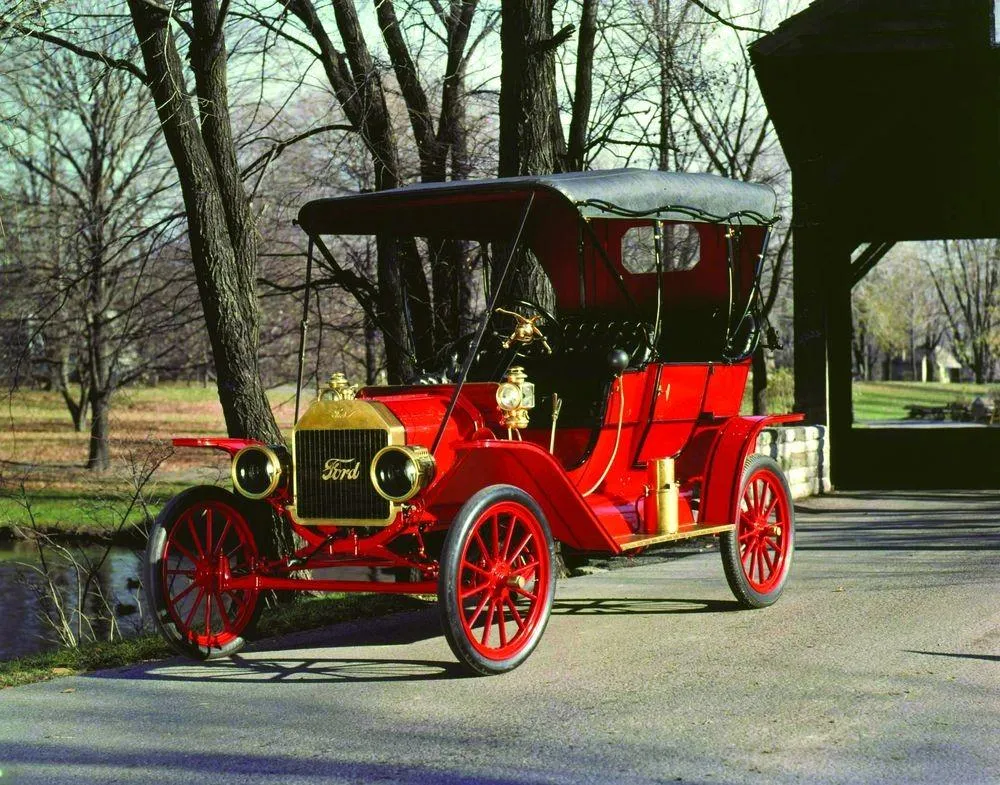 Photo: Model T, via stories.hemmings.com
The Klaxon horn, introduced around 1908, was an improvement in sheer volume. It used a vibrating metal disc driven by a hand crank or, later, an electric motor. The sound was harsh, mechanical, and deeply unpleasant — but it was loud. For a while, loud was enough.
Enter the Electric Horn — and the People Who Wanted It to Sound Good
Electric horns started appearing on production cars around 1910, and they changed everything. Instead of mechanical vibration, an electromagnet rapidly struck a metal diaphragm, producing a tone that could be tuned. Suddenly, the sound of a car horn wasn't just a byproduct of mechanical force — it was something you could actually control.
This is where the story gets interesting. Engineers at companies like Sparton Corporation and Gabriel began experimenting with horn pitch and tone quality, not just volume. The question they were asking wasn't just "can people hear this?" but "does this sound communicate urgency without being needlessly aggressive?"
 Photo: Sparton Corporation, via data.militaryembedded.com
The answer they landed on, after considerable testing, was rooted in basic music theory. A horn pitched around the note F — specifically in the 400 to 500 Hz range — was found to cut through ambient traffic noise effectively while remaining tonally distinct from engine sounds and road noise. It wasn't a random choice. It was the product of acoustic engineering applied to a problem most people assumed had no real solution.
Some manufacturers went further. Sparton, in particular, became known for producing multi-tone horns that played harmonically related notes — essentially a brief chord rather than a single blast. The reasoning was that a harmonious combination of pitches carried further and was perceived as more urgent than a single flat tone. A few luxury carmakers in the 1920s and 1930s installed horns that played recognizable musical intervals, turning the warning signal into something almost melodic.
The Federal Government Gets Involved
For decades, horn standards were informal — manufacturers did what sounded good to them, and drivers made do. But as traffic volumes exploded after World War II and highway speeds climbed, the patchwork of horn designs started creating real problems. Horns that were too quiet failed to warn in time. Horns that were too aggressive contributed to urban noise complaints that cities were starting to take seriously.
Federal Motor Vehicle Safety Standards, developed through the 1960s and formalized in the early 1970s, eventually established minimum sound output requirements for automotive horns. The regulations didn't dictate musical pitch, but they set decibel floors at specific distances — essentially ensuring that every horn sold in America had to be audible enough to actually serve its safety function.
What the regulations couldn't standardize was culture. And that's where things get genuinely fascinating.
Why Americans Treat the Horn Like an Insult
Drive in Mumbai, Cairo, or Naples and the horn is a constant conversational tool — a way of saying "I'm here," "I'm passing," "the light changed," or simply "hello." It's woven into the rhythm of driving the way turn signals theoretically are in the United States.
American drivers, by contrast, have developed a deeply personal relationship with the horn. Honking at someone in the US carries social weight that goes well beyond the mechanical warning it was designed to deliver. It implies judgment. It implies frustration. In many contexts, it implies a confrontation is being invited.
Transportation researchers have noted that this cultural gap isn't about the horn itself — it's about the driving environment. American suburban car culture developed around relatively wide roads, lower urban densities, and an expectation of personal space that extended to the road. Honking became an intrusion into that space rather than a neutral communication.
The horn, in other words, didn't just become a safety device. It became a social signal — one loaded with enough meaning that most American drivers would rather sit silently behind someone running a red light than risk the confrontation of a single honk.
The Sound You Never Noticed
The next time you hear a car horn — really hear it — notice that it has a pitch. It sits somewhere specific on the musical scale. That didn't happen by accident. Somebody thought carefully about what a warning should sound like, argued about it with colleagues, and eventually landed on a note that would cut through noise without becoming noise itself.
That's the hidden story behind the most ignored piece of engineering on your car. The horn wasn't designed to be annoying. It was designed to be heard. The fact that Americans turned it into a social weapon is entirely on us.