Glass Towers and Ghost Dealerships: America's Century-Long Quest to Buy a Car Without Talking to Anyone
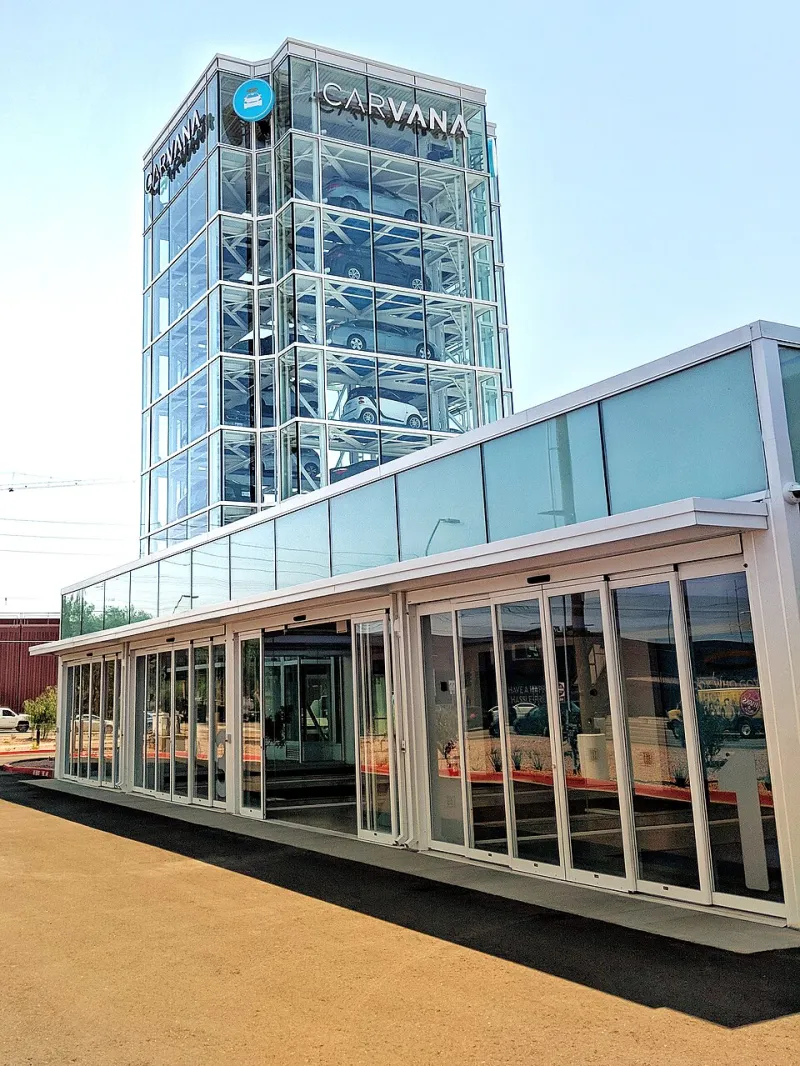
Photo: Elephanthunter, CC BY-SA 4.0, via Wikimedia Commons
Imagine a vending machine eight stories tall, made entirely of glass, filled with cars. You tap a screen, insert an oversized coin, and your chosen vehicle descends from the tower on a mechanical platform while you watch from below. It sounds like something from a 1962 World's Fair concept pavilion.
It's actually a Carvana dealership in Nashville, and it opened in 2013.
The glass tower was a marketing stunt, obviously. But underneath the spectacle was something genuine: another chapter in a very old American story about how desperately people want to buy a car without having to negotiate with another human being.
The Original Car Salesman Problem
The dealership experience has been a source of consumer misery almost since the automobile itself was invented. By the 1910s, as car ownership started expanding beyond wealthy early adopters, manufacturers needed retail networks — and the franchise dealership model emerged as the dominant solution. Dealers bought inventory from manufacturers and sold to the public, pocketing a margin in between.
The problem was structural. A dealer who already owned the car had every incentive to extract maximum profit from every transaction. The customer, who might buy a car once every five or seven years, was perpetually at an information disadvantage. The salesperson knew the invoice price, the holdback, the financing markup, and every other lever in the deal. The customer knew what they'd read in a magazine.
This dynamic — expert seller, uninformed buyer, high-stakes negotiation — produced exactly the kind of experience you'd expect. By the mid-twentieth century, the car dealership had become one of the most reliably dreaded consumer environments in America.
Sears Tried This First
Here's the part most people don't know: Americans were trying to buy cars through the mail before most people even owned one.
In the early 1900s, Sears — then America's great catalog retailer — briefly sold automobiles through its mail-order catalog. The idea was simple: browse the options at home, place an order, receive your vehicle. No salesroom floor. No commission-hungry closer. No negotiation.
The experiment didn't last. The logistics of shipping automobiles were genuinely complicated, and the cars of the era required enough mechanical knowledge and local support that remote purchasing created more problems than it solved. But the impulse behind it — the desire to remove the human friction from car buying — never went away.
Through the following decades, that impulse kept surfacing in different forms. Some manufacturers experimented with factory-direct sales. Consumer advocates pushed for price transparency. Auto shows let buyers browse without pressure. None of it fundamentally changed the dealership dynamic.
The Superstore Moment
The most serious pre-internet challenge to the traditional dealership came in the 1990s, when a wave of automotive entrepreneurs decided that scale and transparency could replace negotiation.
CarMax opened its first location in Richmond, Virginia in 1993, offering used cars at fixed, non-negotiable prices. The pitch was straightforward: no haggling, no games, just a price on the window that was the actual price. The superstore format — enormous inventory, clean facilities, salaried salespeople who weren't working on commission — was designed to make the experience feel less like combat.
 Photo: Richmond, Virginia, via img.drz.lazcdn.com
AutoNation followed a similar playbook for new cars. Republic Industries, which owned AutoNation, briefly became the largest automotive retailer in the country by buying up dealerships and attempting to impose a more consumer-friendly model across them.
Wall Street loved the story. Consumers responded positively to the no-haggle approach. And then the franchise laws kicked in.
Every state in America has franchise protection laws that make it extraordinarily difficult for manufacturers to sell cars directly to consumers, and equally difficult for anyone to dramatically reshape the retail structure. Dealerships, through their industry associations, had spent decades building political infrastructure that protected their position. The superstore moment ran into that wall and slowed considerably.
Enter the Glass Tower
Carvana arrived in the early 2010s with a proposition that felt genuinely new: buy a used car entirely online, have it delivered to your home, return it within seven days if you don't like it. The glass towers were never the real product. They were theater — a visual metaphor for a process that actually happened on a website.
The company grew explosively, fueled by the same consumer frustration that had been building for a century. Online reviews of the experience were, by dealership standards, remarkable. People talked about buying a car in twenty minutes. About not having to argue about financing. About the relief of a transaction that felt like buying anything else online.
Carvana's financial story became complicated — the company took on enormous debt during its growth phase and ran into serious trouble when interest rates rose. But the consumer appetite it tapped into was real, and it forced traditional dealerships to take digital retail more seriously than they ever had.
What the Pattern Tells Us
Sears's mail-order cars. CarMax's no-haggle floors. Carvana's vending machine towers. Each of these experiments emerged from the same source: the gap between how much Americans love cars and how much they hate acquiring them.
The romance of car ownership — the freedom, the identity, the open road — has always coexisted with the reality of the buying process, which is adversarial by design. Every attempt to bridge that gap has met some version of the same resistance, whether from franchise laws, logistics problems, or the simple fact that cars are complicated enough that most people still want some human involvement somewhere in the process.
The dealership hasn't been replaced. But it's been pressured, reformed, and embarrassed by a century of people trying to build a better alternative. That pressure has produced real changes: more price transparency, more online tools, more fixed-price options.
The glass tower full of cars was always a little ridiculous. But the frustration that built it is completely understandable.