The Frozen Disaster That Convinced America Cars Were the Future
The Race Nobody Expected to Matter
November 28, 1895, was a miserable day for a car race. Snow had been falling in Chicago for hours, turning streets into rivers of slush and mud. The temperature hovered around freezing, and a bitter wind whipped off Lake Michigan. Any sane person would have stayed indoors.
 Photo: Lake Michigan, via www.awesomemitten.com
Instead, hundreds of curious Chicagoans gathered at Jackson Park to watch six "horseless carriages" attempt something that seemed borderline insane: a 54-mile race from Chicago to Evanston and back, through the worst driving conditions imaginable.
The Chicago Times-Herald had organized this spectacle partly as a publicity stunt and partly to settle a growing argument: Were automobiles legitimate transportation, or just expensive toys for rich eccentrics?
By the end of that frozen, chaotic day, America had its answer.
When Horses Still Ruled the Roads
In 1895, the automobile was barely a curiosity in America. Most people had never seen one, let alone ridden in one. The few cars that existed were handmade contraptions that broke down constantly, scared horses, and required their owners to be part-time mechanics.
Horses remained the undisputed kings of American transportation. They were reliable, self-repairing (through rest and food), and could navigate any terrain. Cars, by contrast, were noisy, smelly, and prone to mysterious mechanical failures that left their operators stranded.
"The horse is here to stay, but the automobile is only a novelty — a fad," proclaimed the president of the Michigan Savings Bank in 1895. This wasn't an unusual opinion; it was conventional wisdom.
The Times-Herald race was designed to challenge that wisdom. Publisher Herman Kohlsaat believed automobiles represented the future of transportation, but he needed to prove it to skeptical Americans who saw cars as European curiosities with no practical value.
Six Brave Souls Enter the Frozen Unknown
Six vehicles lined up at the starting line that morning, representing the cutting edge of 1890s automotive technology. There were electric cars, steam-powered vehicles, and gasoline engines — each with devoted supporters who insisted their technology would dominate the future.
The Duryea Motor Wagon, built by brothers Charles and Frank Duryea in Springfield, Massachusetts, was the only American-built gasoline car in the race. The rest were imports: German Benz vehicles and a French Peugeot, plus electric cars that seemed promising until the cold weather sapped their battery power.
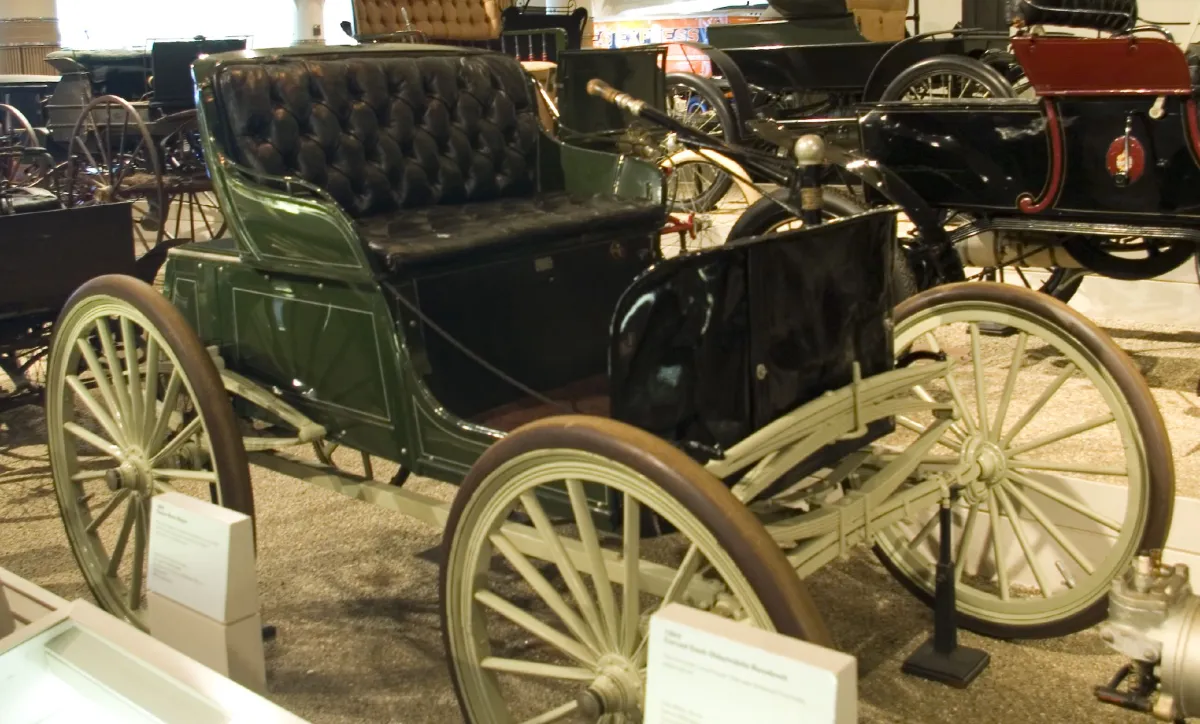 Photo: Duryea Motor Wagon, via topworldauto.com
The rules were simple: drive from Jackson Park to Evanston, get your car inspected by race officials, then return to Chicago. First car back wins $2,000 — about $70,000 in today's money.
What organizers didn't anticipate was how brutally difficult the course would become once snow started falling.
A Comedy of Mechanical Disasters
The race began at 8:55 AM with great fanfare and almost immediately devolved into farce. Within the first few miles, cars began breaking down with predictable regularity.
The electric vehicles, which had seemed promising in early testing, discovered that cold weather killed their batteries. One by one, they coasted to a stop and had to be pushed or towed back to Chicago by horses — the ultimate humiliation for machines supposedly representing the future.
The steam cars faced different problems. Their boilers took forever to heat up in the cold, and they consumed enormous amounts of water that kept freezing in their tanks. One steam car spent more time stopped for repairs than actually moving.
Meanwhile, the gasoline engines struggled with primitive carburetors that couldn't handle the cold, wet conditions. Drivers had to stop constantly to clean spark plugs, adjust fuel mixtures, and restart engines that died without warning.
"It was like watching a parade of mechanical disasters," wrote one newspaper reporter who followed the race. "Every few blocks, another car would sputter to a halt, leaving its driver standing in the snow looking bewildered."
Two Survivors and a Very Slow Winner
By late afternoon, only two cars remained in the race: the Duryea Motor Wagon and a German Benz driven by Oscar Mueller. Both had broken down multiple times, but their drivers had managed makeshift repairs that kept them moving.
The Duryea car, driven by Frank Duryea himself, reached Evanston first and began the return journey. But mechanical problems continued to plague both vehicles. Duryea's car lost its steering mechanism and had to be steered by hand for several miles. Mueller's Benz suffered a broken axle that required roadside welding.
As darkness fell, both cars were still crawling through Chicago's streets, their drivers exhausted and frozen. Spectators who had gathered to watch the finish grew impatient and began heading home.
Finally, at 7:18 PM — more than 10 hours after the race began — Frank Duryea's Motor Wagon crossed the finish line. He had averaged 6.6 miles per hour, barely faster than a brisk walk. Mueller's Benz arrived an hour and a half later, averaging 5.1 mph.
The Disaster That Changed Everything
By any objective measure, the race was a catastrophe. Four of six cars never finished. The winner took more than 10 hours to cover 54 miles. Mechanical failures were constant, and both finishing cars required extensive repairs along the route.
Yet newspaper coverage was overwhelmingly positive. The Chicago Times-Herald declared the race a triumph, emphasizing that automobiles had successfully completed a long-distance journey under terrible conditions without killing anyone or causing major accidents.
More importantly, the race captured America's imagination in ways organizers never expected. Newspapers across the country ran front-page stories about the "horseless carriage race." Editorial writers debated whether automobiles might actually have a future in American transportation.
"The fact that any of these machines completed such a difficult course suggests they may be more than mere novelties," wrote the New York Times. "Perhaps there is something to this automobile idea after all."
Planting Seeds of Automotive Dreams
The race's real impact wasn't immediate; it was psychological. For the first time, large numbers of Americans had seen automobiles attempting to do something useful rather than just puttering around parks for entertainment.
Yes, the cars broke down constantly. Yes, they were slower than horses. Yes, they required constant mechanical attention. But they had completed a genuine test of endurance under miserable conditions, proving that automobiles could potentially handle real-world transportation challenges.
Investors took notice. Within months of the race, new automobile companies began forming across the Midwest. Inventors who had been tinkering with motorized vehicles in their barns suddenly found financial backers willing to fund their experiments.
"The Chicago race proved that automobiles weren't just rich men's toys," explains automotive historian James Flink. "They were machines with genuine potential, even if that potential was still largely unrealized."
The Backstory of American Mobility
That frozen November day in 1895 marked the beginning of America's love affair with automobiles. The race didn't prove that cars were ready to replace horses — that would take another decade of development. Instead, it planted the idea that automobiles might someday transform American life.
Within 20 years, Henry Ford's assembly line would make cars affordable for ordinary Americans. Within 30 years, automobiles would outnumber horses in most American cities. Within 50 years, the interstate highway system would reshape the entire country around automotive transportation.
All of that began with six brave drivers willing to risk mechanical disaster and public humiliation in a Chicago snowstorm. They proved that sometimes the most important races aren't won by the fastest competitor, but by anyone willing to cross the finish line at all.
The next time you're stuck in traffic, remember that America's automotive future began with two cars crawling through slush at walking speed, driven by men too stubborn to quit when any reasonable person would have given up.
That determination, more than speed or reliability, turned out to be the most important ingredient in the recipe for America's automotive revolution.